
Uncategorized
Shilajit in Pregnancy: Why Doctors Advise Against It and What to Do
Avoid shilajit while pregnant or breastfeeding. No controlled trials, contamination risk, and one case links use to high blood pressure. Inform your…

Shilajit gummies can plausibly support energy and general wellness for consistent daily users, but the human evidence behind most marketed claims is thin, and the gummy format itself trades dosing accuracy for convenience. The deciding factor is not the marketing copy on the label. It is whether the brand can show a batch-specific lab test proving the product is free of heavy metals.
TL;DR:
- Most marketed claims about shilajit gummies’ benefits, such as increased energy and immunity, are not supported by rigorous human clinical trials.
- The only well-supported benefit in studies involves increased testosterone and DHEAS in men over 45 taking around 250 to 500 mg daily for at least 8 weeks.
- Contamination with heavy metals remains the primary safety concern; verify each batch with a Certificate of Analysis before purchasing.
- Gummies usually contain lower doses of active shilajit compared to resin or capsule formats, which can affect efficacy and cost-effectiveness.
- Those seeking proven, safe, and cost-efficient shilajit should prioritize products with transparent lab testing and appropriate dosage, especially if targeting specific health goals.
Scroll through almost any shilajit gummy listing and you will see a familiar cluster of promises: more energy, better stamina, stronger immunity, faster recovery after workouts, anti-aging effects, sharper focus, and support for testosterone or fertility in men. Some brands stack in ashwagandha or other adaptogens to broaden the pitch even further.
The claims trace back to shilajit’s bioactive content. Fulvic acid is the compound most often credited with helping the body absorb minerals and neutralize free radicals. Dibenzo-alpha-pyrones (DBPs) and their metabolites, including urolithins, get mentioned for cellular energy support. Trace minerals like magnesium, potassium, and calcium round out the profile, since shilajit forms over centuries from decomposed plant matter compressed in high-altitude rock.
Gummy composition varies a lot between brands. A typical label lists a shilajit extract amount per gummy, often blended with cane sugar, pectin or gelatin, and sometimes a companion herb. Commonly, shilajit content per gummy is well below the doses used in most clinical research.
The trade-off is straightforward: gummies are easy to take and easy to remember, but they generally pack less active shilajit per serving than resin or standardized capsule extracts. A product page comparing gummy and resin formats lays out that difference side by side for anyone deciding between the two.
The honest answer is that human evidence for shilajit is narrow, and most of the broader claims rest on preclinical work rather than controlled trials in people.
A 90-day randomized trial found purified shilajit at 250 mg twice daily raised testosterone and DHEAS in men aged 45 to 55, according to the Pandit study. That is a real signal, but it is one trial in one narrow population, not a blanket endorsement of every claim on a gummy label.
Both trials used doses in the 500 mg per day range, split across servings. Independent reviews, including a Cleveland Clinic summary, describe shilajit’s evidence base as limited overall, with many marketed benefits extrapolated well beyond what the trials measured. Treat shilajit as complementary support rather than a primary treatment for any condition.
Contamination, not efficacy, is the bigger risk with shilajit products. Raw shilajit is mined from rock and can carry heavy metals if it is not purified and tested. Australian health authorities have flagged this repeatedly for Ayurvedic products generally: a Victorian Government health advisory warns that some Ayurvedic medicines have been found with dangerous concentrations of scheduled poisons and heavy metals, and recommends consumers avoid unverified imports.
The TGA’s alert on Kumar Kalyan Rasa tablets is a concrete example: testing found extremely high concentrations of heavy metals, prompting a recommendation to stop use, dispose of the product safely, and see a doctor. Independent lab work has echoed the concern more broadly. Analytical testing of commercial shilajit samples using LIBS, ICP, and EDX methods has detected toxic elements like lead, arsenic, and mercury above safe limits in some products, alongside the beneficial minerals shilajit is sold for.
Before buying, check for:
Pro Tip: Ask the seller for the COA of the exact batch you are buying, not a generic one from the product page.
Multi-ingredient gummies deserve extra scrutiny. Ashwagandha, a common add-in, has its own TGA safety advisory covering rare but serious liver and gastrointestinal reactions.
Clinical trials that showed benefits ran for at least 8 weeks, using approximately 500 mg of shilajit daily, often split into multiple doses. It usually takes weeks of consistent use to notice effects. To approximate research dosing, check the label for mg of shilajit extract per gummy and calculate accordingly.
Gummies suit people who want a low-effort daily habit: gym-goers looking for general recovery support, or anyone who struggles to stick with resin or capsules. Expect modest, gradual effects rather than a dramatic shift.
Shilajit is not appropriate for everyone. Avoid it if you are pregnant or breastfeeding, have severe liver or kidney disease, or take medications that could interact with its mineral content, and check with a doctor first in any of those cases.
The biggest misconception about shilajit is not that it does nothing. It is that people assume the entire marketing list has been tested, when only testosterone and a couple of strength and fatigue markers have decent trial support. That narrow evidence base is actually shilajit’s strongest argument: a real, replicated signal in men’s hormone health is worth more than a dozen unverified claims about immunity and anti-aging.
Where conventional advice falls short is on safety. Most articles spend a paragraph on contamination and move on. Given how often testing has turned up heavy metals in Ayurvedic products, that risk deserves at least as much attention as whether the supplement “works.” If you take one thing from this guide, prioritize the COA over the ingredient list. A product with modest, honest claims and a clean lab report beats one promising everything with nothing to back it up.
— Shilajit
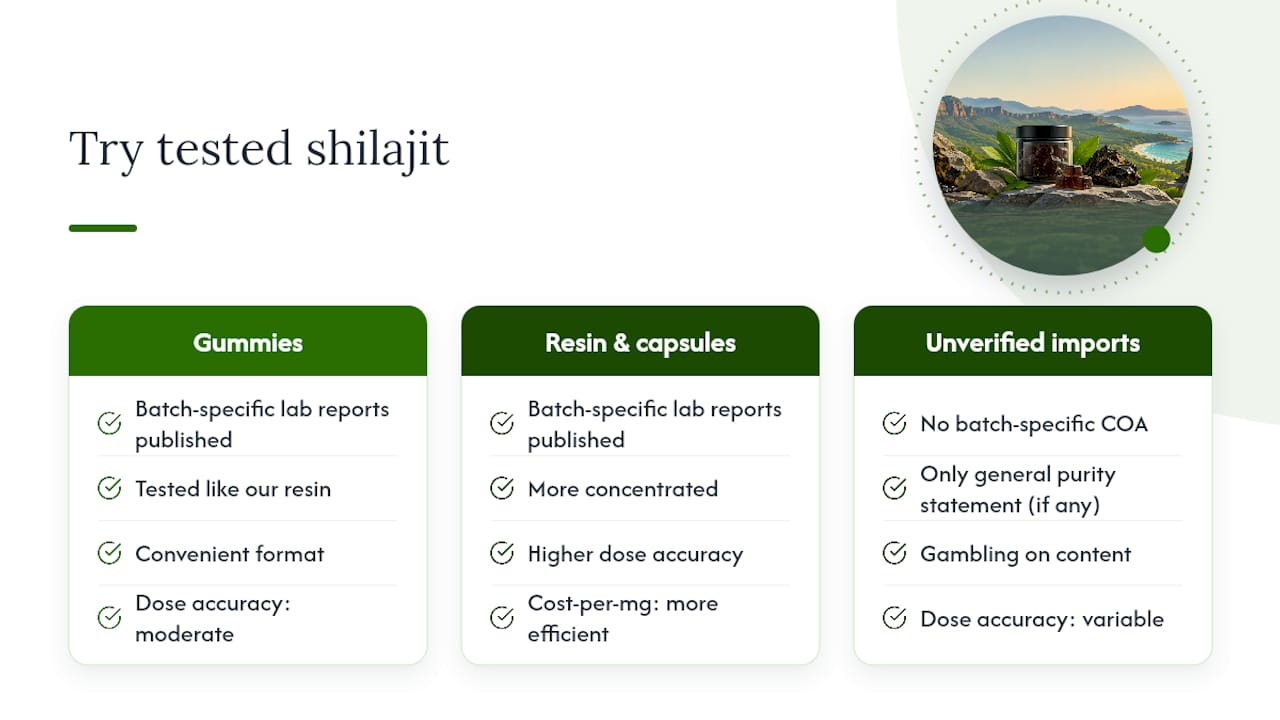
If you want to try shilajit without gambling on an unverified import, look for a supplier that publishes batch-specific lab testing alongside the product, not just a general purity statement. 
Our shilajit gummies are tested with the same transparency we apply to our resin, so you can check what is actually in the batch you are buying before it ships. If dose accuracy matters more to you than convenience, our resin and capsule options give you a more concentrated, cost-per-milligram-efficient alternative. Browse the full shilajit range to compare formats and find the one that fits how you actually take supplements.
Gummies typically cost more per milligram of active shilajit than resin or capsules, because you are paying for flavoring, added sugar, and the manufacturing process that turns raw extract into a chewable format. Resin, sold as a raw concentrated paste, tends to offer the lowest cost per effective dose since there is little else in the jar besides the shilajit itself.
Capsules sit in between: they cost more to produce than resin but still deliver a standardized amount without the sugar load of a gummy. If you are trying to hit a research-aligned dose of around 500 mg per day, the math matters. A gummy with a modest milligram count per piece may require two or three gummies to approach that target, while a single resin serving or capsule dose gets you there directly.
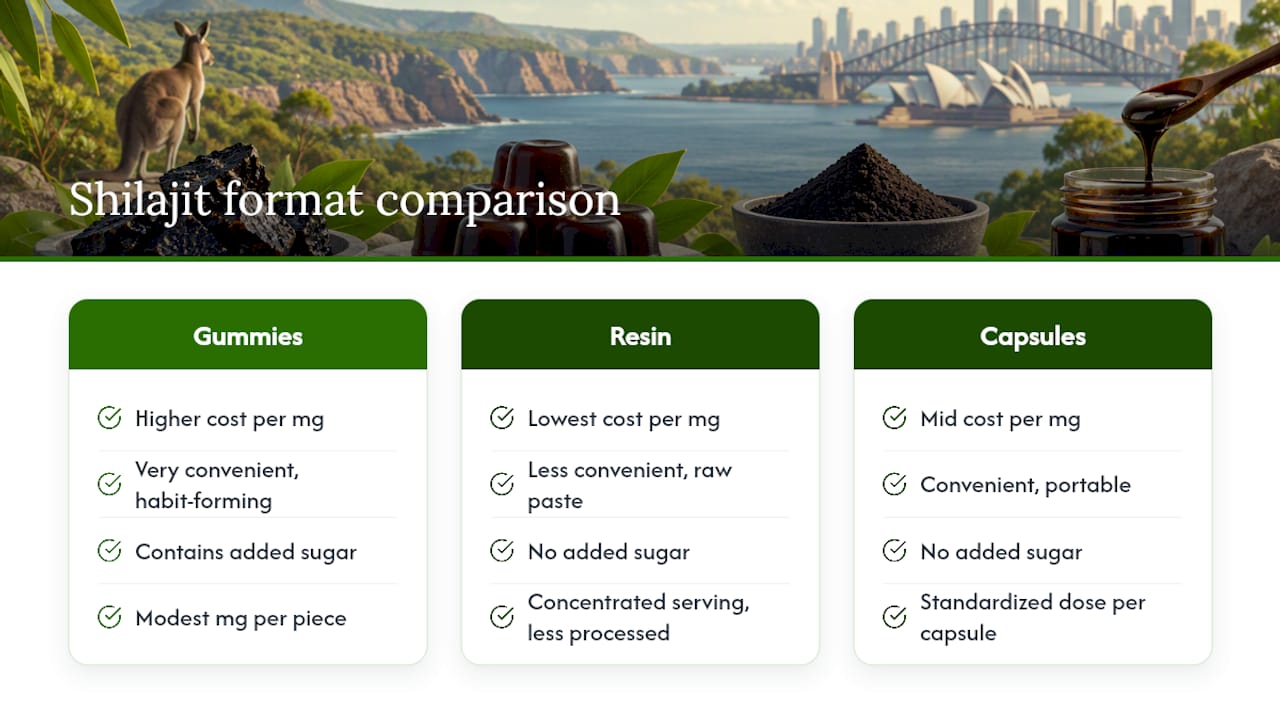
For most casual users who want the habit-forming ease of a gummy and are not chasing a specific research dose, the extra cost is a reasonable trade for convenience. For anyone dosing with a specific health goal in mind, comparing the milligram amount per dollar across resin, capsules, and gummies before buying is worth the five minutes it takes.
This article is general information, not a substitute for advice from a qualified doctor. Consult a qualified healthcare professional about your own circumstances before acting on anything here.
Shilajit gummies are marketed for energy, immunity, and general wellness support, though solid human trial evidence mainly covers testosterone in men and some strength and fatigue markers. Treat other claims, like anti-aging or cognitive benefits, as traditional use backed mostly by preclinical research rather than confirmed human outcomes.
Most people who take shilajit daily at research-aligned doses report gradual improvements in energy and stamina rather than an immediate effect, based on the 8-week and 90-day trial windows used in published research. Any noticeable heavy-metal-related symptoms, such as digestive upset or unusual fatigue, warrant stopping the product and checking its lab testing.
The clearest human evidence for men comes from a 90-day randomized trial showing that purified shilajit at 250 mg twice daily raised total and free testosterone and DHEAS in men aged 45 to 55. Other claims about male vitality and fertility are common in marketing but lack the same level of trial support.
Shilajit gummies can work as a convenient way to take a daily dose, but they often contain less active shilajit per piece than resin or capsules, so results depend on checking the label and the batch’s lab report. Effects, where supported by research, tend to appear gradually over 8 weeks or more rather than immediately.
Avoid shilajit while pregnant or breastfeeding. No controlled trials, contamination risk, and one case links use to high blood pressure. Inform your…
Australia-focused look at shilajit gummies: what human trials actually show, how 500 mg/day dosing compares, and why batch COAs and TGA safety checks matter.