
Uncategorized
Shilajit in Pregnancy: Why Doctors Advise Against It and What to Do
Avoid shilajit while pregnant or breastfeeding. No controlled trials, contamination risk, and one case links use to high blood pressure. Inform your…


Pure shilajit resin delivers higher fulvic acid concentration and faster absorption than most capsule products, making it the stronger choice for potency-focused users. Capsules win on convenience, taste, and dosing precision, which makes them the better fit for travelers, beginners, and anyone who finds measuring sticky resin impractical.
TL;DR:
The table below covers the dimensions that actually matter when choosing between these two forms of shilajit-style supplements.
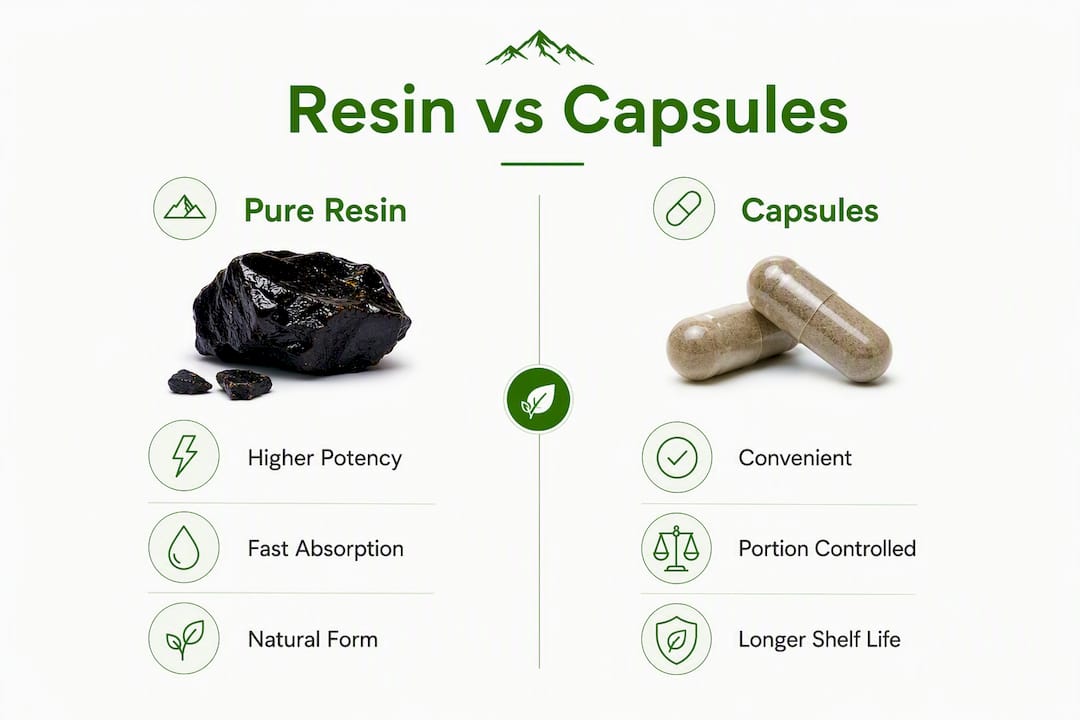
| Dimension | Pure Resin | Capsules |
|---|---|---|
| Bioavailability / absorption | Faster when dissolved in warm liquid; bypasses capsule shell dissolution | Delayed 20–30 min depending on shell type; enteric coatings can improve intestinal delivery |
| Potency (fulvic acid %) | Typically 60–80% fulvic acid | Typically 20–50% fulvic acid in many products |
| Dosing accuracy | Requires measuring (rice-grain method); learning curve | Pre-measured; consistent per dose |
| Convenience / portability | Sticky, requires a jar and spoon; less travel-friendly | Portable, discreet, no prep needed |
| Taste / odor | Strong, earthy, bitter | Masked by capsule shell |
| Purity / fillers | Minimal processing; fewer excipients in quality products | May include binders, flow agents, or fillers depending on manufacturer |
| Price / value per active dose | Higher upfront cost; often cheaper per active mg due to concentration | Lower upfront cost; higher cost per active mg in many products |
| Shelf life / storage | 6–12 months after opening; needs airtight, cool storage | Longer sealed shelf life; sensitive to humidity once opened |
| Best suited for | Potency seekers, experienced users, home routines | Travelers, beginners, taste-sensitive users, microdosing |
Trust signals to check on any product page:
For a deeper breakdown of how these formats perform in practice, the resin vs capsule comparison guide on Shilajit covers user outcomes and switching guidance.
Bioavailability is the proportion of an active compound that actually reaches your bloodstream and cells after you consume it. For shilajit, the key bioactive is fulvic acid, a small organic molecule that acts as a cellular transporter, helping minerals and nutrients cross cell membranes more efficiently. The form you take directly affects how much of it gets absorbed and how fast.
When you dissolve resin in warm water or milk, the fulvic acid is already in a semi-liquid, partially dissolved state. Your digestive system skips the step of breaking down a solid matrix, so absorption begins sooner. Capsules, by contrast, require the shell to dissolve first. Depending on whether the shell is standard gelatin, HPMC (hydroxypropyl methylcellulose), or an enteric-coated material, that process can delay active release by 20–30 minutes.
Several factors reduce bioavailability regardless of form:
Advanced capsule technologies, including HPMC-based shells and enteric coatings, can protect actives from stomach acid and deliver them further into the intestine. That is a genuine advantage for certain formulations, though it does not close the gap in raw fulvic acid concentration that separates most resin products from most capsule products.
Fulvic acid percentage is the most useful single benchmark for comparing shilajit products, because it reflects both the quality of the source material and how much active content survived processing. Resin typically reports 60–80% fulvic acid, while many capsule products report 20–50%. That range matters: a product at the low end of the capsule range delivers roughly a quarter of the active content per gram compared to a high-quality resin.
Capsule manufacturing involves several steps that can reduce active compound levels. Raw shilajit must be dried, ground into powder, blended with excipients (flow agents, anti-caking agents, binders), and then encapsulated. Heat and pressure during drying are the main culprits. Sensitive organic molecules like fulvic acid can degrade when exposed to elevated temperatures, and the longer the processing chain, the more opportunity for active content to drop.
Resin, by contrast, undergoes minimal processing. Traditional preparation involves sun-drying and filtering to remove particulates, which preserves the natural fulvic acid matrix and the associated trace minerals.
How to read a product label and COA for potency:
Pro Tip: If a product page lists “humic acid complex” without specifying fulvic acid separately, ask the vendor for the fulvic acid fraction specifically. Brands with nothing to hide will have it on the COA.
Resin is the least-processed form of shilajit you can buy, and that minimal processing is both its biggest advantage and the source of most of its practical drawbacks.
Pros:
Cons:
Pro Tip: Dissolve your resin portion in warm (not boiling) water, herbal tea, or milk. Heat above roughly 70°C can degrade fulvic acid, so aim for a comfortable drinking temperature. Adding a small amount of raw honey improves palatability and does not interfere with absorption.
Capsules remain dominant in the U.S. nutraceutical market for good reason: they solve the three problems most supplement users care about most — taste, convenience, and dosing consistency. For shilajit specifically, those advantages are real, though they come with trade-offs on potency.
Pros:
Cons:
Capsules make the most practical sense when you are traveling, starting out with shilajit for the first time, or managing a regimen where consistent dosing matters more than maximum potency. For a full buying guide covering capsule formulations and what to look for on the label, the Shilajit capsule guide is worth reading before you order.
The right form depends on your lifestyle, goals, and tolerance for a bit of daily prep. Here is how to self-select.
Decision criteria:
User profiles:
Quick decision checklist:
Pro Tip: If you are unsure, start with capsules for 4–6 weeks to establish your baseline response, then switch to resin and compare how you feel. The difference in energy and focus is often noticeable enough to make the decision for you.
Getting the dose right matters more with resin than with capsules, because the concentration is higher and the margin for error is smaller.
Capsule dosing typically ranges from 500–1,000 mg to achieve active-compound exposure comparable to a rice-grain portion of resin, because the fulvic acid concentration per gram is lower. Follow the label on your specific product, since fulvic acid percentages vary.
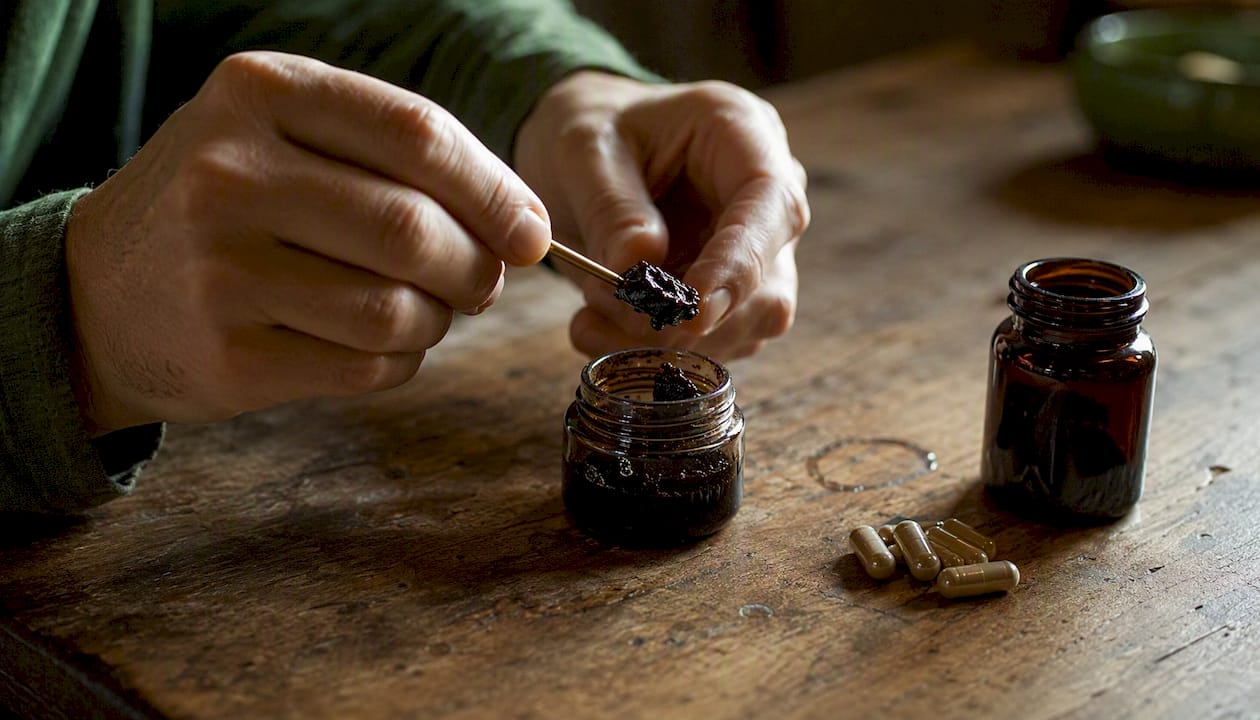
Switching from capsules to resin: Reduce your starting resin amount by 30–50% relative to what you might expect from the capsule dose. A user taking 1,000 mg of capsules daily should start resin at 300 mg and titrate up, not jump straight to a gram-equivalent portion.
Pro Tip: Space shilajit at least two hours away from prescription medications, particularly anticoagulants, blood pressure drugs, and diabetes medications. Fulvic acid can affect how certain compounds are absorbed, so timing separation is a simple precaution worth taking.
If you want a broader view of how shilajit fits into a wellness supplement routine, the energetic wellness supplement guide covers supplement categories and lifestyle matching in plain language.
A Certificate of Analysis is the single most important document a shilajit vendor can provide. Without one, any potency or purity claim is marketing, not evidence.
COA checklist — what to look for:
| COA Field | What to Look For | Red Flag |
|---|---|---|
| Fulvic acid % | Specific number (e.g., 72%) | “High potency” with no number |
| Heavy metals | Results in ppm with stated limits | Missing panel or “compliant” with no data |
| Microbiology | Absence of pathogens confirmed | No microbiology section at all |
| Batch number | Matches product label | Generic COA with no batch reference |
| Lab accreditation | ISO 17025 or equivalent | In-house or unnamed lab |
| Test date | Within 18 months | Undated or very old |
Requesting a COA when it is not posted: Email the vendor with your batch number and ask for the full third-party COA. A transparent brand responds within 24–48 hours with the actual document. Vague replies (“our products are tested to the highest standards”) without a document attached are a signal to look elsewhere.
Pro Tip: Cross-reference the batch number on the COA against the number printed on your jar or packet. If they do not match, the COA was not run on the product you received. That mismatch is grounds to request a replacement or a refund.
Shilajit is generally well-tolerated at recommended doses, but a few safety signals are worth knowing before you start, particularly if you are switching to a higher-potency resin form.
Common side effects (typically dose-related):
High-potency resin users report more noticeable early effects; the standard guidance is to start at half the suggested dose and increase only after monitoring your response for at least one week.
Interaction cautions — consult a clinician if you take:
Groups who should speak with a clinician before starting:
Start low, monitor your response over the first week, and stop use if you experience severe reactions. This is general information, not medical advice; confirm current guidance with a qualified healthcare professional before starting any new supplement.
The sticker price on a jar of resin is usually higher than a bottle of capsules, but that comparison is misleading without accounting for active content per dose.
How to calculate cost per effective dose:
Divide the product price by the number of servings, then adjust for fulvic acid percentage. A 50-gram jar of resin at 70% fulvic acid delivers roughly 35 grams of active fulvic acid. A 60-capsule bottle where each 500 mg capsule contains 30% fulvic acid delivers 9 grams of active fulvic acid. Even if the capsule bottle costs less upfront, the resin delivers nearly four times the active content per dollar in this example. Resin’s higher concentration makes it more economical per active dose despite the higher purchase price.
| Form | Typical fulvic acid % | Effective active content per gram | Relative cost per active mg |
|---|---|---|---|
| Pure resin (quality product) | 60–80% | higher concentration | Lower |
| Capsules (typical range) | 20–50% | lower concentration | Higher |
Shelf life and storage:
Opened resin lasts 6–12 months when stored correctly. Sealed capsules typically last longer, though they are sensitive to humidity once opened. Both forms degrade faster in heat and direct sunlight.
Pro Tip: Store resin in a small glass jar with an airtight lid, in a cool, dark drawer or cabinet. If you notice the texture becoming unusually hard or the color shifting significantly, take a small amount and dissolve it in warm water. Fresh resin dissolves cleanly; degraded resin may leave a gritty residue or smell noticeably different from when you first opened it.
Pure resin delivers higher fulvic acid concentration and faster absorption than most capsule products, making it the stronger choice for potency-focused users, while capsules offer superior convenience, taste masking, and dosing consistency for travelers and beginners.
| Point | Details |
|---|---|
| Potency gap is real | Resin typically contains 60–80% fulvic acid vs. 20–50% in many capsule products. |
| COA is non-negotiable | Always verify a batch-matched, third-party COA with a heavy metals panel before buying either form. |
| Dosing differs by form | A rice-grain resin portion (~300–500 mg) often matches the active content of 500–1,000 mg of capsules. |
| Safety first | Start at half the suggested dose, space away from medications by two hours, and consult a clinician if on prescription drugs. |
| Shilajit resin | Lab-tested pure resin with a published COA is the recommended option for users prioritizing fulvic acid potency and absorption. |
Full disclosure: Shilajit sells lab-tested pure Himalayan Shilajit resin, and that commercial interest shapes this recommendation. That said, the reasoning stands on its own.
The most common mistake supplement buyers make is treating form as a secondary consideration. It is not. A capsule product with a vague “humic complex” label and no COA is a worse purchase than a lab-tested capsule with a clear fulvic acid percentage, regardless of price. And a high-quality resin with a published COA, a specific fulvic acid percentage, and batch-matched testing is the strongest option for anyone who wants to know exactly what they are getting and how much of it reaches their cells.
Capsules are a legitimate choice. For travelers, beginners, and anyone who will not take something daily because the taste is intolerable, a well-formulated capsule beats an unused jar of resin every time. Compliance matters. But for users who are serious about potency, who want to minimize excipients, and who are willing to spend 60 seconds dissolving a rice-grain portion in warm water each morning, resin delivers more active content per dose at a lower cost per active milligram.
The COA is where this decision gets made. A lab-tested capsule with a clear fulvic acid percentage can outperform an uncertified resin. Transparency is the real differentiator, not the jar versus the capsule.
If you have read this far and potency is your priority, the 50-gram pure Shilajit resin from Shilajit is a practical starting point. Each batch is third-party tested with a published COA covering fulvic acid percentage, heavy metals, and microbiology. The product page includes dosing instructions and the batch report so you can verify what you are buying before it arrives.
For users who want to understand purity metrics in more depth before ordering, the Himalayan Shilajit purity guide walks through how sourcing altitude, processing method, and lab testing interact to determine active content. If you are still deciding between forms, compare the COA on the resin product against any capsule product you are considering. The fulvic acid percentage will do most of the deciding for you.
If you are working with a nutritionist or considering professional guidance on your supplement regimen, choosing the right nutritionist covers what to look for in a qualified practitioner who can help you match supplements to your specific health goals.
Cross-reference any COA you receive against the batch number on your product. If the numbers do not match, the document was not generated for what you purchased.
Avoid shilajit while pregnant or breastfeeding. No controlled trials, contamination risk, and one case links use to high blood pressure. Inform your…
Australia-focused look at shilajit gummies: what human trials actually show, how 500 mg/day dosing compares, and why batch COAs and TGA safety checks matter.