Uncategorized
6 Point Shilajit Lab Report Checklist for Australian Buyers
Verify Shilajit lab reports in Australia with a six point checklist. Spot fake COAs, check lab accreditation, lot match, analytical methods, and LODs.

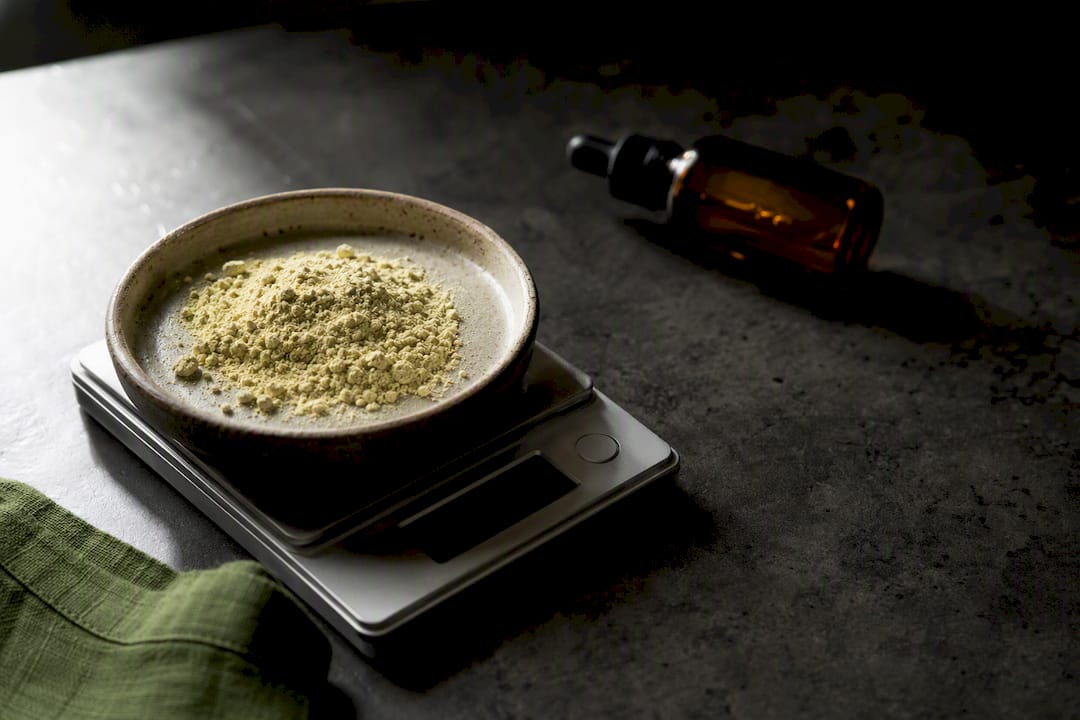
Pine pollen powder is generally dosed in a small daily range for maintenance, tinctures at about one dropperful once or twice a day, and capsules by matching their milligram count to a similar range. Skip it entirely if you have a known pollen allergy, and treat any hormone-related claims with skepticism since human clinical evidence remains thin. Many people cycle tincture use rather than taking it every single day.
TL;DR:
- Use powder in the 1 to 3 gram daily range, preferably mixed with fats, for general nutritional support.
- Tincture doses typically range from 0.5 to 1 mL once or twice daily, with sublingual absorption enhancing effectiveness.
- Capsules are ideal for convenience and consistency but lack flexibility for dose adjustments once taken.
- Start with low doses for a week to monitor tolerance, cycling tincture with five days on and two days off to prevent receptor downregulation.
- Avoid pine pollen if you have pollen allergies or hormone-sensitive conditions, and always verify product quality with cracked-cell-wall processing and third-party testing.
Powder, tincture, and capsules behave differently in the body, so the right pine pollen dosage depends heavily on which one you have in your hand. This is the part most product labels get vague about, and it’s where people either waste money or take more than they need.
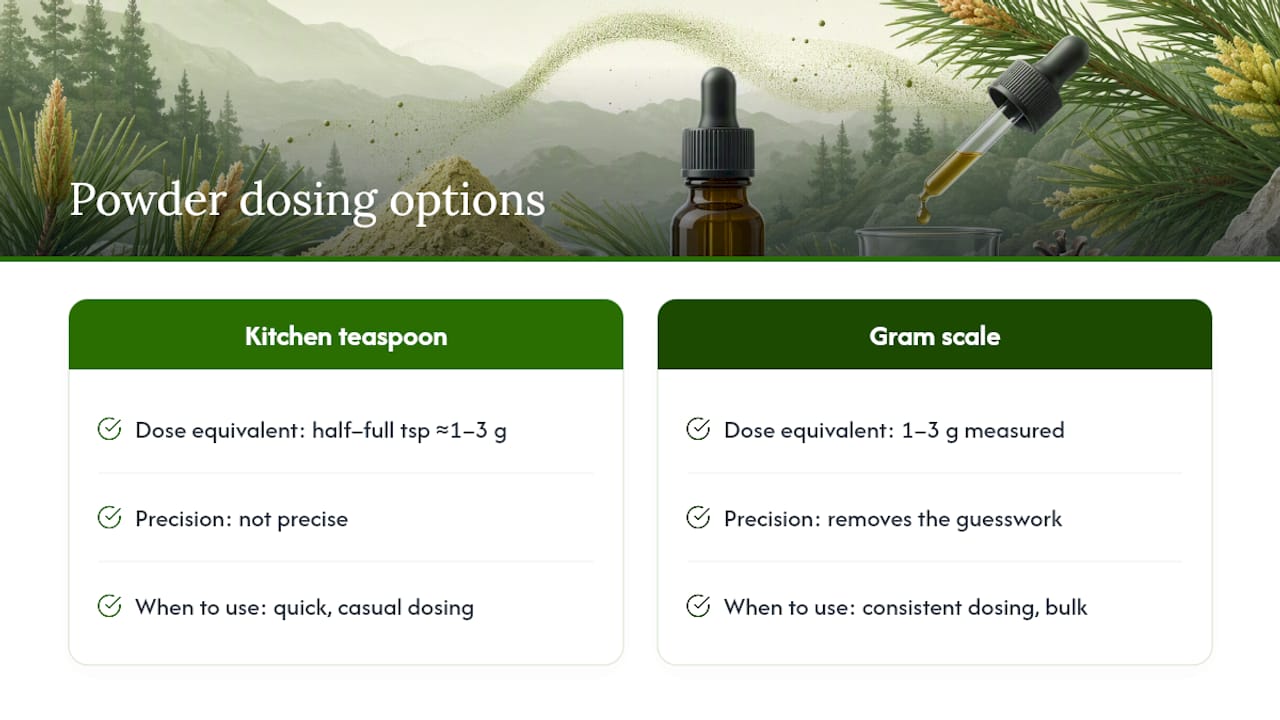
Start with a half to a full teaspoon, which works out to roughly 1 to 3 grams. That is also the standard maintenance range most supplement guides settle on for daily use, according to Anabolic Health’s dosing breakdown. A kitchen teaspoon isn’t a precise measuring tool, so if you want consistency, a small gram scale removes the guesswork, especially once you’re buying in bulk.
Some practitioner protocols suggest higher short-term dosing occasionally for specific goals, but there is no strong safety data supporting sustained use at higher amounts. There’s no strong safety data behind sustaining that higher range long term, so treat it as an occasional ceiling and not a target.
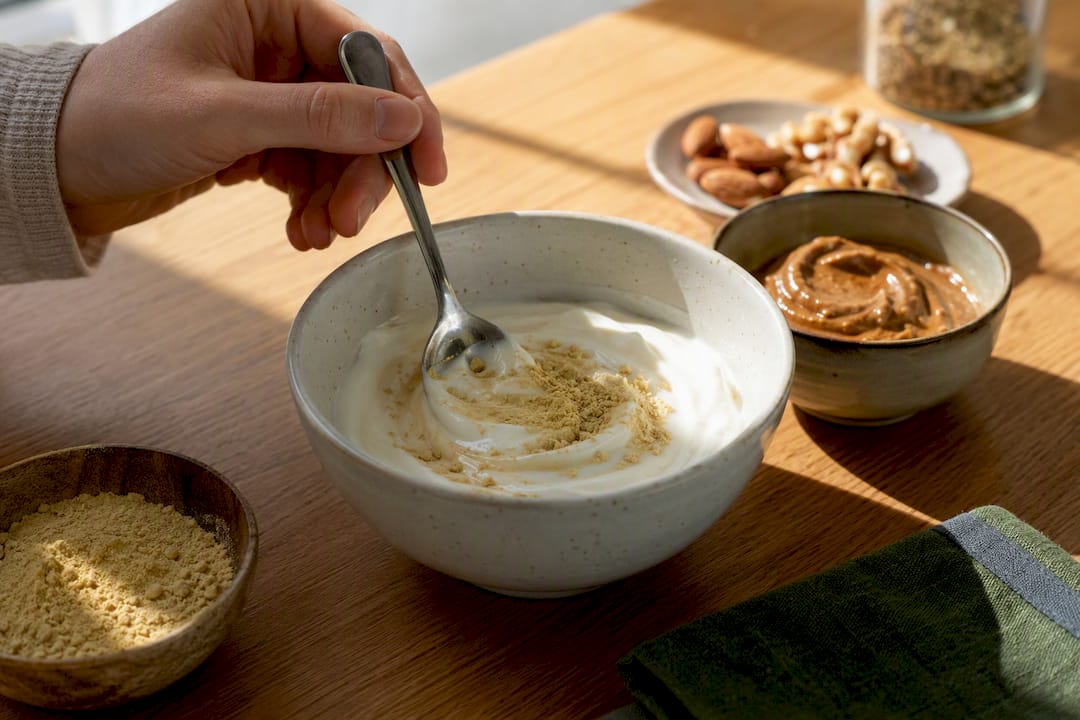
Pro Tip: Mix powder into something with a bit of fat, like yogurt or a smoothie with nut butter. Pine pollen’s beneficial compounds are fat-soluble, and pairing them with a meal that contains fat may help your body use them more efficiently.
Tinctures are measured in dropperfuls, and one dropperful is generally around 1 mL, which lines up with about 30 drops. NDNR’s clinical overview of pine pollen phytoandrogens points to a typical range of 0.5 to 1 mL taken once or twice daily, and that’s the window most tincture users work within.
The technique matters here almost as much as the amount. Hold the tincture under your tongue for 30 to 60 seconds before swallowing, since sublingual absorption is the entire reason tincture exists as a format, according to Healthline’s overview of pine pollen products. Swallow it immediately and you’re mostly just drinking alcohol extract that has to survive digestion first.
Morning or early afternoon tends to be the preferred window for tincture, partly because some users report a mild stimulating effect that can interfere with sleep if taken too late.
Capsules are the easiest form to standardize, with common capsule sizes allowing several pills daily to approximate a small total dose range.
Where capsules fall short is flexibility. You can’t titrate a capsule the way you can a teaspoon of powder or a dropper of tincture, so they suit people who want a fixed, repeatable serving more than people trying to fine-tune a dose. If you’re just starting out and want predictability while you gauge how your body responds, capsules remove a lot of the guesswork that comes with eyeballing powder.
It’s worth being honest about what tincture actually does. The idea behind it is that pine pollen contains natural phytoandrogens, plant compounds structurally similar to human androgens, and that concentrating them into a tincture delivers a more direct effect than the diluted amount in raw powder. But human evidence for measurable testosterone increases from pine pollen is weak, and most of what people feel is likely tied to the pollen’s broader nutritional profile rather than any hormone-level shift.
Jumping straight to a “typical” dose on day one is how people end up blaming pine pollen for a stomach ache that was really just too much, too fast. A short titration period tells you more about your own tolerance than any dosage chart ever will.
A five days on, two days off pattern is the most common cycling schedule you’ll see recommended for tincture users. The reasoning behind it borrows from a broader supplement principle: the theory is that continuous exposure to any compound acting on hormone receptors can lead to the body downregulating its own sensitivity over time. That theory hasn’t been formally tested for pine pollen specifically, but it’s a low-cost precaution, so plenty of experienced users build it into their routine anyway.
Beyond the weekly pattern, a lot of people also take a full week off every 8 to 12 weeks, essentially a longer reset layered on top of the shorter weekly cycle. Powder doesn’t carry the same cycling convention, since it’s used more like a nutritional supplement than a targeted hormonal one.
Morning or early afternoon dosing is the safer default, particularly for tincture. If you’re sensitive to stimulating supplements, taking pine pollen within a few hours of bedtime can disrupt sleep for some people, the same way a late afternoon coffee might. Powder taken with a meal tends to be gentler on timing since food slows absorption somewhat.
If you’re using both forms, keep them distinct in purpose rather than doubling up on the same goal. Powder covers the nutritional baseline, vitamins, minerals, and amino acids that don’t require precise dosing. Tincture is the more deliberate, targeted layer for anyone specifically interested in the phytoandrogen angle. Running both at once without a plan just muddies your ability to tell what’s actually working, which defeats the purpose of tracking anything in the first place.
Pollen allergy is the single biggest red flag to check before you take your first dose. Anyone with a known sensitivity to tree or grass pollen should avoid pine pollen altogether, since it carries the same allergenic proteins that trigger seasonal reactions, according to guidance from the Better Health Channel on pollen allergy. If you’ve ever needed antihistamines during pine season, that’s a signal worth taking seriously here.
Watch for these reaction signs and stop immediately if any appear:
A 2020 literature review examined 239 pine pollen publications, including 180 pharmacological studies and 37 clinical trials, and found the safety picture to be reassuringly mild: eight trials reported no adverse events at all, while one noted mild gastrointestinal reactions, according to the PMC review of pine pollen pharmacology and clinical uses. That’s a genuinely encouraging safety signal, but it comes with a caveat worth sitting with: most of that research base is pharmacological and animal-focused rather than large-scale human trials, so the evidence for pine pollen’s marketed hormone benefits is a lot thinner than the evidence for its basic tolerability.
That distinction matters for how you should read any bold marketing claim you come across. A supplement can be well-tolerated and still lack solid proof that it does what the label implies, and pine pollen currently sits in exactly that spot.
Anyone managing a hormone-sensitive condition, whether that’s a history of hormone-responsive cancer, endometriosis, or a similar diagnosis, should get medical guidance before adding a supplement marketed around androgenic activity. The same goes for anyone currently on hormone replacement therapy or blood thinners, since interactions haven’t been well studied. Pregnant or breastfeeding people, along with children, should avoid pine pollen outright given the absence of safety data in those groups.
If you’re on any prescription medication and unsure how pine pollen might interact, a quick conversation with a pharmacist or your general practitioner costs you nothing and closes a real gap in what’s currently known.
“Cracked-cell-wall” is the phrase to look for on any powder label, and it’s not marketing fluff. Pine pollen grains have a tough outer shell that human digestion doesn’t break down efficiently on its own, so unbroken pollen largely passes through the body without releasing its nutrients. Processing that mechanically ruptures the cell wall is what makes the contents actually available for absorption.
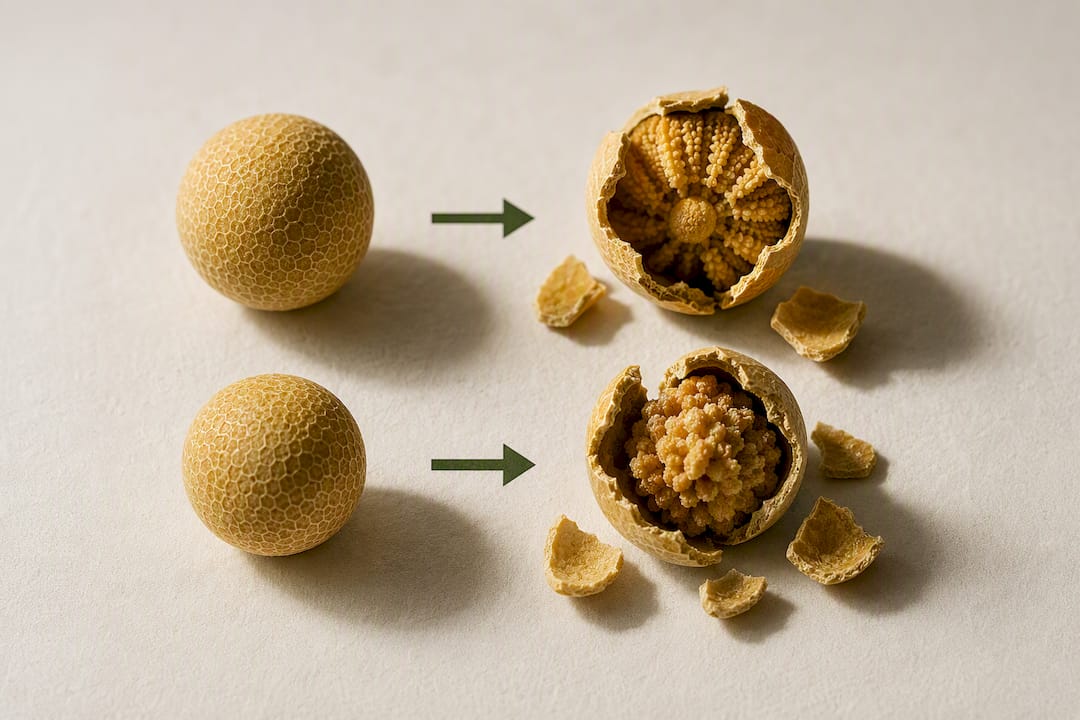
Processing choices affect more than just that one detail. Drying method, sterilization, and how the wall is disrupted all influence how well the pollen’s bioactive compounds hold up between harvest and the jar you buy, according to research on processing effects and bioavailability. A poorly processed batch can look identical to a well-processed one on the shelf while performing very differently once you actually take it.
Before you buy, check for:
Reading a label properly means translating vague serving language into something you can actually measure. If a jar says “one scoop,” ask what that scoop weighs in grams. If a tincture bottle doesn’t list mL per dropperful, that’s a gap worth asking about before you buy, since dosing consistency depends entirely on knowing that number.
Between the two extremes, unmeasured bulk powder and pre-dosed capsules or tinctures, the measured formats are the safer starting point if you don’t already own a gram scale. Shilajit’s guide to pine pollen powder options walks through what separates a well-processed product from one riding on vague claims, and the practical usage guide for testosterone-focused users covers dosing specifics in more depth if that’s your particular interest.
Some brands focus on lab-tested purity for Himalayan resin, and similar standards can apply to pine pollen powder, emphasizing processing transparency and dosing clarity. We don’t publish a serving size without explaining what it means in practical terms, because a gram figure without context is just a number on a label.
What we prioritize when it comes to product quality:
If you’re managing a chronic condition, taking prescription medication, or simply uncertain where you fall on the allergy question, a conversation with an Australian GP or pharmacist beats guessing based on a forum post. Our product page for pine pollen powder lays out serving sizes and processing details plainly, so you’re working from the same information we are, not a marketing summary of it.
The gap between how pine pollen is marketed and what the evidence actually supports is wider than most product pages admit. Tincture is sold on the promise of a direct hormonal effect, but the human data behind that promise is genuinely thin, built mostly on pharmacological studies rather than trials measuring real testosterone changes in real people.
That doesn’t mean skip it. It means calibrate your expectations before you calibrate your dropper. Powder’s nutritional value is the more defensible reason to take pine pollen at all, and the phytoandrogen angle should be treated as a bonus worth testing cautiously, not a guaranteed outcome worth chasing aggressively.
If there’s one place conventional advice falls short, it’s the confidence with which dosing charts get presented as settled science. They’re not. They’re informed estimates drawn from practitioner experience and a small pool of trials. Start low, track how you respond, and let your own results, not a label’s bold claim, decide whether to go further.
— Shilajit
If you’re taking pine pollen for its broader nutritional and vitality support, Shilajit’s Himalayan resin fills a complementary role that pine pollen alone doesn’t cover: mineral density and fulvic acid content that support energy and recovery from a different angle. Instead of stacking supplements based on guesswork, pairing a purity-tested resin with a properly processed pine pollen powder gives you two ingredients doing distinct, non-overlapping jobs.
Every batch of Shilajit’s pure Himalayan resin comes with lab testing behind it, the same standard we hold pine pollen products to. That matters if you’ve read this far and care about knowing what’s actually in your supplement rather than trusting a label’s word for it. Our guide to Himalayan Shilajit purity breaks down exactly what that testing covers and why it’s worth checking before you buy from anyone.
If energy, recovery, and mineral support are part of why you’re looking at pine pollen in the first place, check out the 50 gram resin and see whether it fits alongside your current routine.
This article is general information, not a substitute for advice from a qualified doctor. Consult a qualified healthcare professional about your own circumstances before acting on anything here.
Verify Shilajit lab reports in Australia with a six point checklist. Spot fake COAs, check lab accreditation, lot match, analytical methods, and LODs.
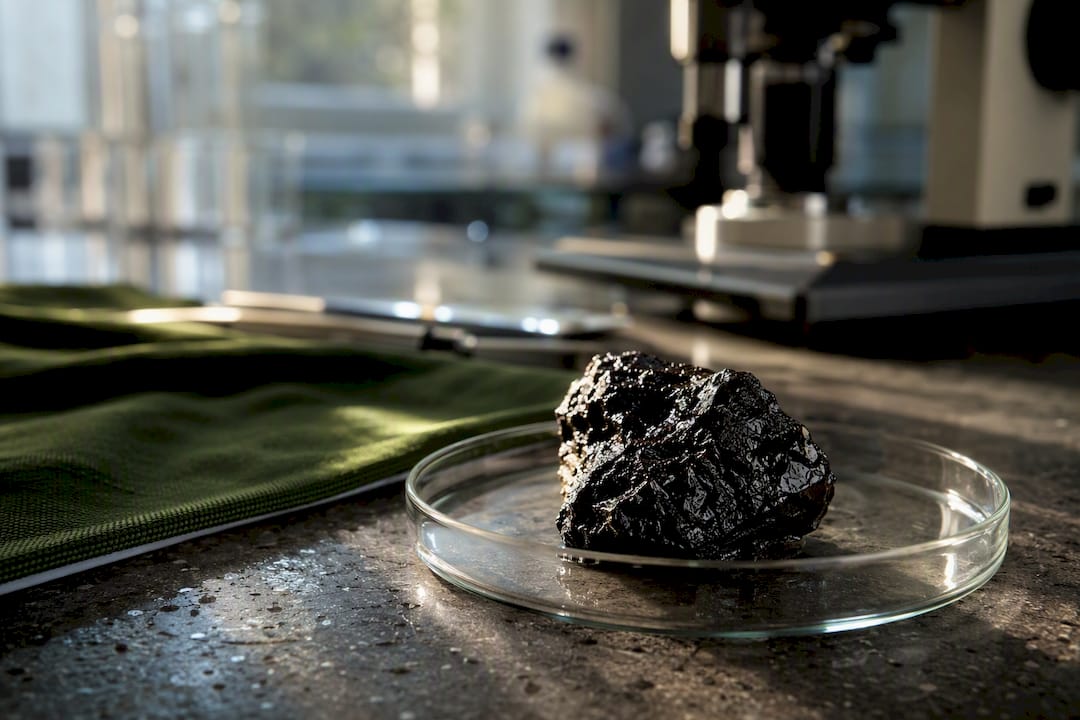
Learn to pick pure shilajit by reading the batch COA. Check fulvic acid range, named lab method, numeric heavy-metal results, and harvest altitude.