
Uncategorized
Shilajit in Pregnancy: Why Doctors Advise Against It and What to Do
Avoid shilajit while pregnant or breastfeeding. No controlled trials, contamination risk, and one case links use to high blood pressure. Inform your…


The strongest Ayurvedic remedies for hair growth are bhringraj, amla, rosemary, green tea (EGCG), ginseng, Gynostemma pentaphyllum, and mineral-rich Shilajit. If you’re starting this week, pick one topical oil and one oral supplement, commit to 12 weeks minimum, and track every four weeks. A 2025 systematic review of 16 randomized controlled trials confirmed that several of these herbs measurably increase hair density and reduce shedding. Most people see the first real changes after consistent use over several months.
Start this week:
TL;DR: Expect measurable changes at 90–180 days. The 2025 systematic review and multiple 24-week RCTs support this timeline.
The table below maps each herb or supplement to its primary use, the shortest trial duration showing a measurable effect, and the main outcome reported.
| Herb / Supplement | Use | Trial duration | Main outcome |
|---|---|---|---|
| Bhringraj | Topical oil | Traditional + lab models | Telogen→anagen transition, vasodilation |
| Amla | Topical + oral | Traditional (complementary) | Antioxidant support, follicle nourishment |
| Rosemary oil | Topical | 24 weeks | Hair count increase comparable to minoxidil |
| Green tea (EGCG) | Topical + oral | 24 weeks | Hair density and diameter increase |
| Ginseng | Oral | Preclinical + short trials | Anagen phase stimulation, reduced cell death |
| Gynostemma pentaphyllum | Oral | 24 weeks | 3× elasticity and density; 4× diameter vs. placebo |
| Aloe vera | Topical | Short trials | Scalp balance, reduced shedding |
| Saw palmetto | Topical | Weeks to months | Reduction in hair fallout |
| Shilajit (mineral/fulvic acid) | Oral | 90+ days | Systemic mineral support, nutrient bioavailability |
The standout from recent research is Gynostemma. A 2025 randomized, double-blind, placebo-controlled trial of 100 adults found a threefold increase in hair elasticity and density and a fourfold increase in hair diameter versus placebo over 24 weeks, with no serious adverse events. Rosemary oil matched minoxidil for hair count at six months in a separate trial. Herbal combinations consistently outperform single-product use: one multi-extract shampoo-plus-solution trial reported greater hair count increases and improved anagen/telogen ratios over several months compared to either product alone.
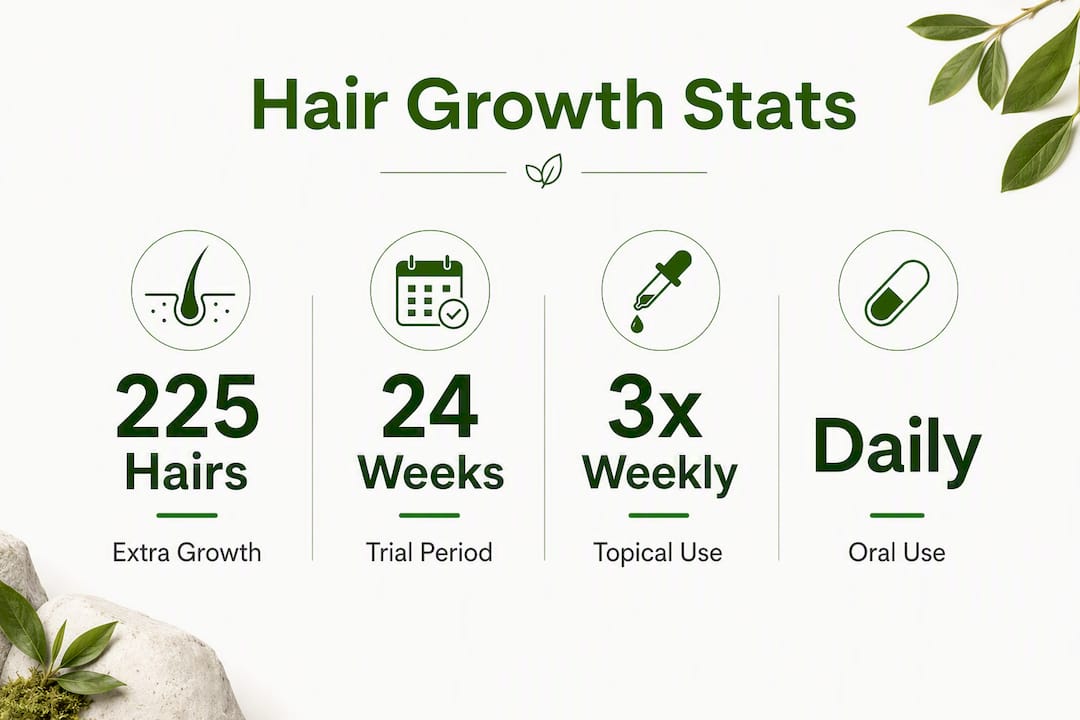
One trial in the 2025 systematic review reported up to 225 additional hairs in a 1.8 cm² area over 24 weeks, and telogen hair was reduced by about 20% in another arm of the same review.
Most effective Ayurvedic herbs work through at least two biological pathways at once, which is why combinations tend to outperform single-ingredient approaches.
Think of it this way: topical herbs address the scalp environment directly, while oral mineral support from Shilajit works systemically, filling nutritional gaps that topical applications simply cannot reach.

Quality is the single biggest variable in herbal supplement outcomes. A standardization review found that inconsistent active compound levels and heavy metal contamination are the two most common failure points in herbal products.
Quality checklist before you buy:
Pro Tip: When reading a COA, the numbers that matter most are the heavy metal results and the active marker compound percentage. A COA that lists only “passes testing” without specific values is not a real COA.
Dosing basics: Clinical trials typically use topical oils several times per week and oral supplements daily over a period of several months. For Shilajit resin, a conservative starting dose is a pea-sized amount (roughly 300–500 mg) dissolved in warm water or milk once daily.
Interactions to watch: Saw palmetto may interact with anticoagulants and hormone therapies. Several Ayurvedic herbs are contraindicated during pregnancy and nursing. If you take thyroid medication, check with your clinician before adding any adaptogenic herb or mineral supplement. Stop any remedy immediately if you notice scalp irritation, rash, or sudden increased shedding beyond your baseline, and get a medical review.
Shilajit is a mineral-dense resin that forms over centuries as plant matter decompresses between Himalayan rock layers. Its two most relevant components for hair health are fulvic acid and a broad spectrum of trace minerals including zinc, iron, and selenium.
Zinc deficiency is one of the most documented nutritional causes of hair loss. Iron deficiency is another. Shilajit’s natural benefits for energy and wellness extend to nutrient delivery: fulvic acid improves the bioavailability of minerals you consume, meaning your body absorbs and uses them more efficiently. Nutraceutical trials consistently show that measurable hair density improvements require at least 90 days of daily supplementation.
Shilajit quality checklist:
How to use resin: Dissolve a pea-sized amount in warm (not boiling) water, milk, or herbal tea each morning. Pair it with your topical oil routine on the same days for a combined systemic and local approach. The Shilajit resin guide covers daily integration in more detail.
Twelve weeks is the minimum commitment. Within weeks, many people notice reduced shedding, and after several months, density and texture changes may become visible.
Weeks 1–4 (build the foundation):
Weeks 5–8 (deepen the routine):
Weeks 9–12 (assess and adjust):
Pro Tip: Combine topical and oral approaches from day one. The 2025 systematic review found that herbal combinations outperform single-product use across multiple outcome measures.
Ninety days is the minimum before drawing conclusions. Clinical evaluations of nutraceuticals report that hair density improvements typically require at least 90 days of daily use, with larger effects at 90–180 days. The 2025 Gynostemma RCT measured its primary outcomes at 24 weeks, which is where the threefold elasticity and density gains appeared.
Stop the remedy and see a clinician if you notice:
If you’re already using a prescribed hair loss treatment, ask your clinician before adding Ayurvedic herbs or mineral supplements. Some combinations are fine; others need monitoring.
This article is general information, not medical advice. Confirm any supplement or treatment with a qualified health professional for your specific situation.
The most effective approach to Ayurvedic hair growth combines daily oral mineral support (lab-tested Shilajit), consistent topical herbal oils (bhringraj, rosemary), and a minimum 12-week commitment tracked every two to four weeks.
| Point | Details |
|---|---|
| Commit to 12 weeks minimum | Clinical trials show measurable changes at 90–180 days; week 12 is the start of the data window. |
| Combine topical and oral | Herbal oil routines address the scalp directly; oral Shilajit fills systemic mineral gaps topicals cannot reach. |
| Verify every product with a COA | Check batch-level heavy metal results and active marker percentages before buying any herbal supplement. |
| Watch for red flags | Sudden sharp shedding, scalp infection, or allergic reaction means stop and see a clinician. |
| Shilajit as mineral foundation | Pure Himalayan Shilajit resin, verified by batch COA, is the recommended oral mineral complement to topical Ayurvedic herbs. |
The conventional wisdom in natural hair care tends to split into two camps: pure traditionalists who swear by ancient Ayurvedic formulas, and supplement skeptics who dismiss anything without a pharmaceutical trial. Both miss the point. The most defensible approach right now sits in the middle: traditional herbs with the strongest clinical backing, paired with a mineral supplement whose quality you can actually verify.
Shilajit earns its place in this regimen not because of marketing claims, but because the nutritional gaps it addresses (zinc, iron, trace minerals, fulvic acid bioavailability) are the same gaps that show up repeatedly in hair loss research. The problem with most Shilajit products on the market isn’t the ingredient; it’s the lack of batch-level testing. Heavy metal contamination is a real risk in unverified resins. Every batch of Shilajit should come with a COA you can read before you open the jar. If it doesn’t, that’s your answer.
The Ayurvedic herbs in this guide work best when you treat them as a system, not a shortcut. Bhringraj oil three times a week, a clean Ayurvedic cleanser, a consistent oral mineral supplement, and enough protein and sleep to support follicle cycling. None of it is complicated. The hard part is the 90-day patience requirement in a world that expects results in two weeks.
If you’ve read this far, you already know that the mineral and fulvic acid foundation matters as much as the topical herbs. Shilajit’s Pure Himalayan Shilajit Resin is sourced from high-altitude Himalayan rock, processed without synthetic additives, and tested at the batch level for heavy metals and fulvic acid content. You get the COA before you commit.

Use a pea-sized amount dissolved in warm water each morning alongside your topical oil routine. The 50-gram jar covers roughly a three-month supply at a standard daily dose, which aligns with the 90-day minimum that clinical evidence supports. If you want to extend the regimen with complementary botanicals, the Shilajit and Pine Pollen bundle pairs mineral support with adaptogenic plant compounds. Check the COA on the product page, then decide. That’s the right order of operations.
For persistent or rapidly worsening hair loss, consult a dermatologist or trichologist before starting any supplement regimen. Cross-check every product you buy against its batch COA.
Avoid shilajit while pregnant or breastfeeding. No controlled trials, contamination risk, and one case links use to high blood pressure. Inform your…
Australia-focused look at shilajit gummies: what human trials actually show, how 500 mg/day dosing compares, and why batch COAs and TGA safety checks matter.