Uncategorized
Shilajit in Pregnancy: Why Doctors Advise Against It and What to Do
Avoid shilajit while pregnant or breastfeeding. No controlled trials, contamination risk, and one case links use to high blood pressure. Inform your…
Choosing shilajit comes down to one habit: refuse to buy any resin, powder, or capsule that doesn’t ship with a batch-matched third-party Certificate of Analysis (COA). That COA needs to name a specific harvest region and altitude, list a fulvic acid percentage measured by a named lab method, and show heavy metal results as actual numbers, not a vague “pass” stamp. Everything else in your decision, the format, the price, the brand story, matters far less than whether that document exists and matches the jar in your hand.
TL;DR:
- Only purchase shilajit with a batch-matched third-party Certificate of Analysis that specifies harvest region, altitude, fulvic acid percentage, and heavy metal results with actual numbers.
- Resin forms retain the most of the original compounds but can be mistaken for flaws due to its sticky texture, and they require proper packaging like wide-mouth jars for scooping.
- Capsules are convenient but often lack transparency about dosage and fulvic acid content, making dose verification difficult, while powders pose high adulteration risks without explicit COA testing.
- Reliable COAs must include licensed lab details, current test dates, numeric heavy metal results, and specified methods like ICP-MS and HPLC for contamination detection.
- Sourcing from high-altitude, well-documented regions like specific valleys in the Himalayas is more trustworthy than vague claims, and brands with long-term relationships with harvesters tend to offer higher quality and sustainability.
Run through this before you add anything to your cart. It takes about three minutes and eliminates most of the bad listings on any marketplace.
Statistic to know: ContractLaboratory’s purity guide notes that raw shilajit resin typically tests in the typical lower range of natural fulvic acid percentages before purification, which is why a listing advertising 80% or 90% fulvic acid deserves real skepticism rather than excitement.
Manufacturing signals matter too. Look for a manufacturing date, a use-by date, and language about GMP-aligned production. None of these guarantee purity on their own, but their absence is a pattern worth noticing.
Format changes both how you use shilajit and how easily someone can fake it.
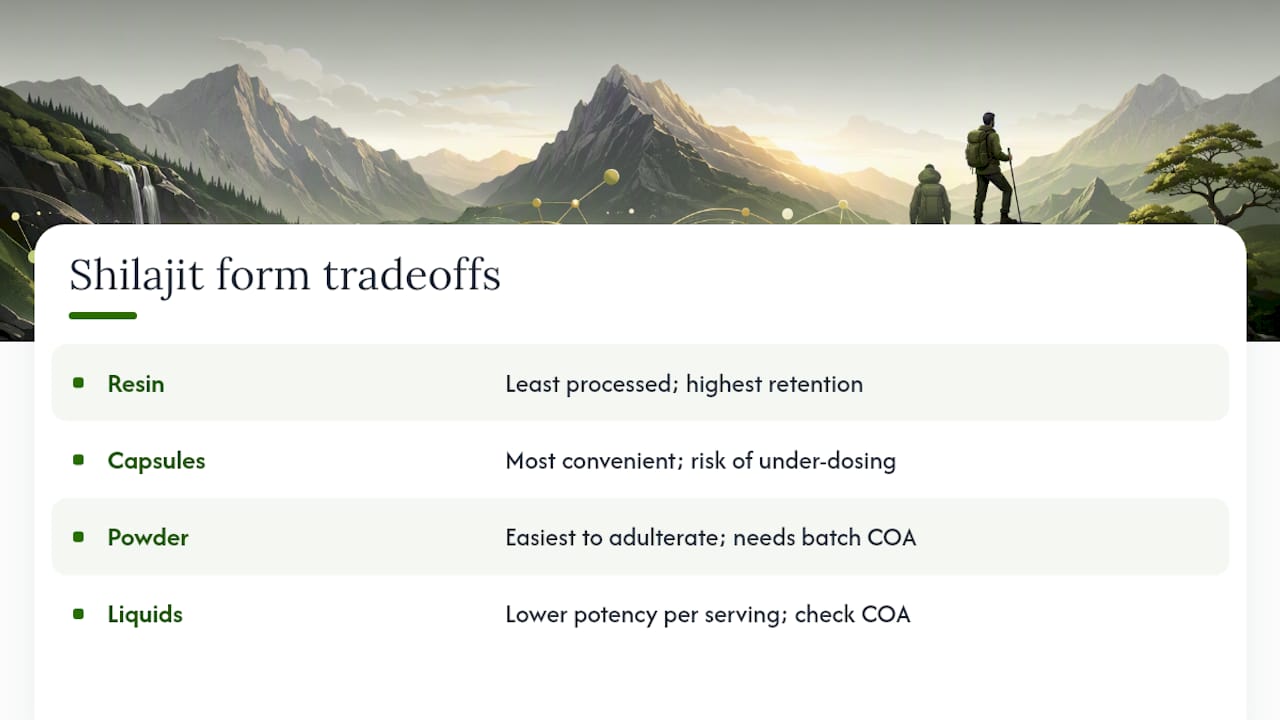
Resin offers the highest retention of the compound profile because it undergoes the least processing after purification. You pinch off a pea-sized amount, dissolve it in warm water or tea, and swallow it. The tradeoff is texture: authentic resin is sticky, dense, and tends to dissolve with some residue, which some new buyers mistake for a flaw. Packaging matters here, too. Look for a wide-mouth jar rather than a squeeze tube, since resin firms up in cold weather and needs to be scooped, not squeezed.
Capsules are the most convenient, no taste, no mess, easy to travel with. Their main risk is under-dosing. A capsule holding 300 to 500 milligrams of shilajit extract is common, but if the label doesn’t state the extract ratio or the fulvic acid content inside that capsule, you have no way to know if it matches an effective dose.
Powders are, according to ContractLaboratory, the easiest format to adulterate, since bulking agents, humic acid from unrelated sources, or even colored fillers blend in visually. Powders can be legitimate when they come from spray-dried resin with a matching COA explicitly stated, but that COA needs to specifically test the powder batch, not the raw resin it was made from.
Liquids, tinctures, gummies, and honey blends trade some potency for stability and taste, but added sugars, alcohol bases, or preservatives can dilute the active dose per serving. Check whether the fulvic acid percentage on the COA refers to the finished liquid or the concentrate before dilution.
Whatever the form, the COA should test that specific product, not a “parent resin” batch three steps upstream.
A Certificate of Analysis is only useful if you know which lines actually matter. Here’s what a trustworthy COA includes:
The analytical methods behind these numbers matter more than most buyers realize. ContractLaboratory recommends ICP-MS or ICP-OES for trace metal testing because these techniques can detect contamination at extremely low concentrations, and HPLC for fulvic acid because it separates and quantifies the compound directly rather than estimating it. A 2025 compositional study of Himalayan shilajit went further, using elemental analysis alongside GC-MS profiling to confirm bioactive compounds like dibenzo-alpha-pyrones, the class of molecules many of shilajit’s claimed benefits are tied to.
A COA that only says “heavy metals: pass” with no numbers attached is not a certificate of analysis. It is a certificate of nothing. Ask for the numeric values, the testing method, and the accredited lab’s name before you trust any purity claim.
ICP-MS deserves special attention. As ContractLaboratory points out, it’s the method required to catch trace toxicants like thallium at very low levels. A brand that only lists a generic “heavy metal screen” without naming ICP-MS or ICP-OES risks missing key contaminants
Fraud usually shows up as a mismatch. The lot number on the bag doesn’t match the COA. The test date is from two years ago on a product claiming a one-year shelf life. Or the same COA gets reused across multiple product listings, which you can sometimes catch by comparing file metadata or simply noticing identical numbers across different “batches.” Clean Shilajit’s COA primer warns specifically against trusting any document that shows a pass or fail label without the underlying data, since that format makes fabrication trivial.
Origin is an important factor to consider as a contamination risk indicator. Shilajit forms over centuries from plant matter compressed in high-altitude rock crevices, and where that rock sits changes what ends up in the final resin.
Regions commonly cited include areas of the Himalayas, the Altai Mountains, and parts of the Caucasus, and quality consistency varies noticeably between them depending on harvesting practices and local regulation. Altitude is the more reliable signal within any of these regions. Material sourced at sufficiently high altitude tends to be farther from industrial runoff, agricultural pesticide drift, and vehicle emissions, all of which can introduce heavy metals into lower-altitude mineral deposits.
If a product page doesn’t publish sourcing detail, contacting the seller may help clarify source when possible. A brand with real traceability answers this in a sentence. One without it tends to deflect toward general claims about “ancient tradition” instead.
Most published research on standardized shilajit extracts uses doses in a moderate milligram range daily, often for standardized extracts, taken over trial periods running anywhere from a few weeks to several months. Translating that to a raw resin serving requires reading the label carefully, since resin isn’t standardized the same way a capsule extract is.
Raw resin dosing is inherently less precise than a standardized capsule, which is exactly why the fulvic acid percentage on the COA matters. It’s the number that lets you estimate what a given pinch of resin is actually delivering.
Heavy metals are the primary concern, specifically lead, arsenic, mercury, and cadmium, because shilajit is a mineral-rich substance pulled from rock, and rock can carry contamination depending on the surrounding environment. Microbial contamination, particularly yeast and mold, is the second concern, especially in poorly dried or improperly stored resin. Both require lab equipment to detect reliably; neither shows up reliably to the naked eye.
Market adulteration tends to follow predictable patterns. Some sellers cut resin with lower-cost humic substances that aren’t from shilajit deposits at all. Others sell powder bulked with fillers that mimic the color and texture. A price far below the category average, vague sourcing language, and stock photography instead of real product images tend to cluster together on the same listings.
These checks are useful for catching obvious fraud, but they have a hard ceiling. At-home tests cannot detect heavy metals or sophisticated synthetic fulvic acid additions, full stop. Only an ISO/IEC 17025 accredited lab report gives you that assurance. Australian buyers importing from overseas sellers should also be aware of the TGA’s personal importation guidance, which outlines the rules around bringing in unapproved therapeutic goods.
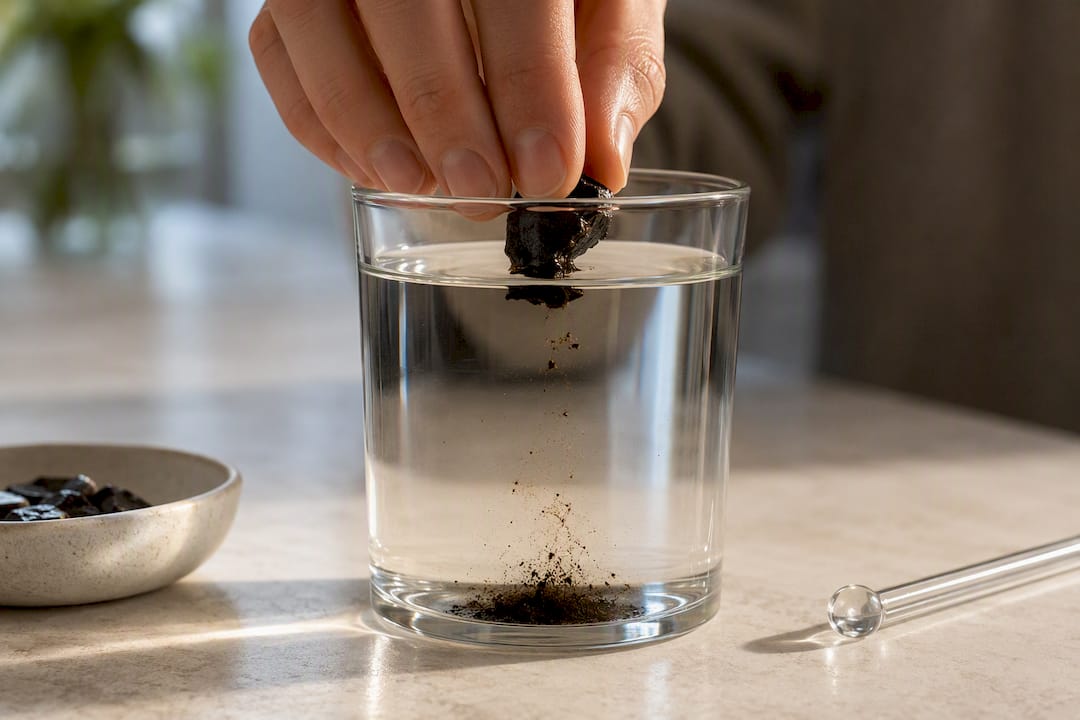
Pro Tip: Dissolve a small piece in room-temperature water and let it sit for ten minutes. Real resin softens unevenly and leaves faint sediment; a completely uniform, instantly dissolving sample often signals added binders rather than pure mineral pitch.
Genuine purification and third-party testing cost money, and that cost has to show up somewhere in the retail price. Reasonable pricing for a 30-day supply varies by format and should be consistent with expected production costs.
Statistic to know: independent audits referenced in Clean Shilajit’s buying guide point to a recurring pattern: products priced well under the category floor for their format disproportionately fail basic authenticity checks when tested. Deep discount bundles and unbranded marketplace listings deserve extra scrutiny for this reason. A legitimate sale on an established brand is different from a price that never made sense in the first place.
A brand that’s confident in its purity doesn’t ask you to take its word for it. Shilajit publishes batch-specific lab reports so buyers can check the exact numbers behind the resin they’re ordering, not a representative sample from a different production run.
These pages map directly onto the checklist above: batch-matched testing, transparent processing, and sourcing detail you can actually verify instead of taking on faith.
Star ratings alone tell you almost nothing about purity. A seller can accumulate hundreds of five-star reviews praising “energy” and “focus” while shipping a product that’s never seen a lab. What actually separates a credible seller from a marketing-heavy one is whether the reputation is backed by something verifiable.
Look at how long the brand has operated and whether it has a fixed, findable business address rather than only a storefront on a third-party marketplace. Check whether customer reviews mention specific, checkable details, texture, dissolving behavior, taste, rather than generic praise. Reviews that read like templates, or that all post within the same short window, are a red flag common to manipulated review sections.
Cross-reference claims across the brand’s own site and independent sources. If a seller claims third-party testing but no COA is visible anywhere on the product page, that’s a mismatch worth flagging regardless of how the reviews read. Independent audits and testing organizations occasionally spot-check supplement categories like this one, and a brand’s willingness to publish results even when they’re not perfect says more than a curated five-star average ever will.
Customer service responsiveness is a smaller but real signal too. A brand willing to answer a direct question about sourcing, testing dates, or shipping batches before you buy is behaving differently than one that only responds after a complaint. Reputation, in this category, is really a proxy for transparency, and transparency is the thing you should be measuring directly whenever you can.
A few direct questions, sent before you order, filter out most unreliable sellers fast.
Ask which specific region and altitude the batch was harvested from, and whether that information can be confirmed in writing rather than just stated in a product description. Ask for the current batch’s COA, not a generic one from the brand’s website, and specifically ask whether it includes numeric heavy metal results and the fulvic acid testing method used. Ask which lab performed the testing and whether that lab holds ISO/IEC 17025 accreditation.
It’s also worth asking about shelf life and storage conditions during shipping, particularly for resin, which is sensitive to heat during transit. Ask what the return or refund policy looks like if the batch COA doesn’t match what’s printed on the packaging when it arrives. A seller with nothing to hide answers these questions promptly and specifically. A seller relying on vague reassurance, “our shilajit is 100% pure and tested,” without ever producing a document, is telling you something important by what they leave out.
Finally, ask about production scale and consistency. A brand that reformulates or resources every few months has a harder time maintaining consistent quality than one with a stable, repeatable sourcing relationship. That consistency is often reflected in whether their COAs look similar in format and detail from batch to batch, rather than varying wildly in what they disclose.
Shilajit forms over an extremely long timescale as plant material gets compressed and mineralized within rock crevices, which means harvesting practices matter more here than in most supplement categories. Overharvesting a single site can outpace the natural formation rate, and some sellers respond to rising demand by pulling from lower-altitude or less-consistent sources without disclosing the change.
Sustainable sourcing generally means working with a stable, small set of harvest sites at documented altitude, rotating collection to avoid depleting any single crevice system, and maintaining a direct relationship with local harvesters rather than buying anonymously through intermediary traders. Brands that can name their sourcing relationship tend to also be the ones publishing consistent, specific origin claims on their COAs, since the two practices reinforce each other.
The opposite pattern shows up as vague, shifting origin language. A brand that describes its material as “Himalayan” one season and drops that detail the next, or that can’t say which valley a batch came from, is often buying opportunistically from whichever supplier has stock, which makes both sustainability and quality consistency hard to guarantee. Ask the same origin questions from the seller-vetting section above; the answers double as a sustainability signal, not just a purity one. A brand with a genuine, long-term sourcing relationship rarely struggles to describe it in detail.
Resin is the most storage-sensitive format. Keep it in its original airtight container, away from direct sunlight and heat, ideally somewhere that stays below room temperature but doesn’t need refrigeration for most climates. Resin naturally softens in warmth and firms up in cooler conditions, and that’s normal, not a sign of spoilage. If it becomes runny or develops a strong off-smell, that’s a different story and worth discontinuing.
Capsules and powders should stay in a cool, dry location, since humidity is the main threat to a powder’s shelf life. Moisture exposure can encourage microbial growth even in an otherwise well-tested product, which is part of why the microbiology panel on a COA reflects conditions at the time of testing, not necessarily six months later on your kitchen shelf.
Once opened, most shilajit products hold their potency for the shelf life stated on the packaging, provided the container stays sealed between uses. Always reseal the jar or cap tightly, and avoid introducing a wet spoon or finger directly into resin, since that’s an easy way to introduce contamination after the fact, even if the product left the lab completely clean. If a product doesn’t list an expiration or best-by date at all, treat that omission the same way you’d treat a missing COA: as a gap worth asking about before you buy.
The rule stands: demand a batch-matched COA, a named source and altitude, and a fulvic acid number that fits real-world ranges. Ancient use of shilajit in Ayurvedic practice is well documented, but tradition alone doesn’t screen for heavy metals. Modern testing and traditional sourcing knowledge work best together, not as competing claims on a label.
— Shilajit
Everything in this guide points to one habit: check the paperwork before you check the price. Shilajit’s resin ships with a batch-matched COA covering heavy metals and fulvic acid content, sourced from high-altitude material with detailed origin information. The product page for the pure shilajit resin lists dosage guidance, shipping details, and return terms right alongside the batch information, so you’re not hunting across three different pages to confirm what you’re buying.
If you want the fuller breakdown of how that resin gets purified and tested before it ships, the purification and purity guide walks through the process in detail. Otherwise, apply the checklist from this guide directly to the product page, confirm the batch number matches, and order the 50-gram resin if it checks out.
This article is general information, not a substitute for advice from a qualified doctor. Consult a qualified healthcare professional about your own circumstances before acting on anything here. Connect with us on Facebook for helpful information, product updates and news about authentic shilajit resin.
Buy only from a seller who publishes a batch-matched COA showing numeric heavy metal results, a named fulvic acid testing method, and a specific harvest origin with altitude. If any of those three is missing, treat the listing as unverified.
There’s no single universally “best” brand, but the strongest candidates are the ones that publish current batch COAs with numeric results rather than pass or fail labels. This information is published alongside the resin so buyers can verify each batch directly.
Resin generally offers the highest retention of the original compound profile and the least processing, making it the preferred choice for most buyers, while capsules suit convenience if the label states extract ratio and dose clearly. Powders carry the highest adulteration risk of any format.
No product should be marketed with an absolute purity guarantee, since even accredited labs report results within a tested range rather than a flat 100% figure. The closest proxy for purity is a current, batch-matched COA from an ISO/IEC 17025 accredited lab showing low or non-detectable heavy metals and a fulvic acid percentage consistent with the product’s format.
Raw resin typically tests around 15% to 20% fulvic acid before purification, according to ContractLaboratory, and claims above roughly 85% on a natural resin product deserve skepticism rather than trust.
Avoid shilajit while pregnant or breastfeeding. No controlled trials, contamination risk, and one case links use to high blood pressure. Inform your…
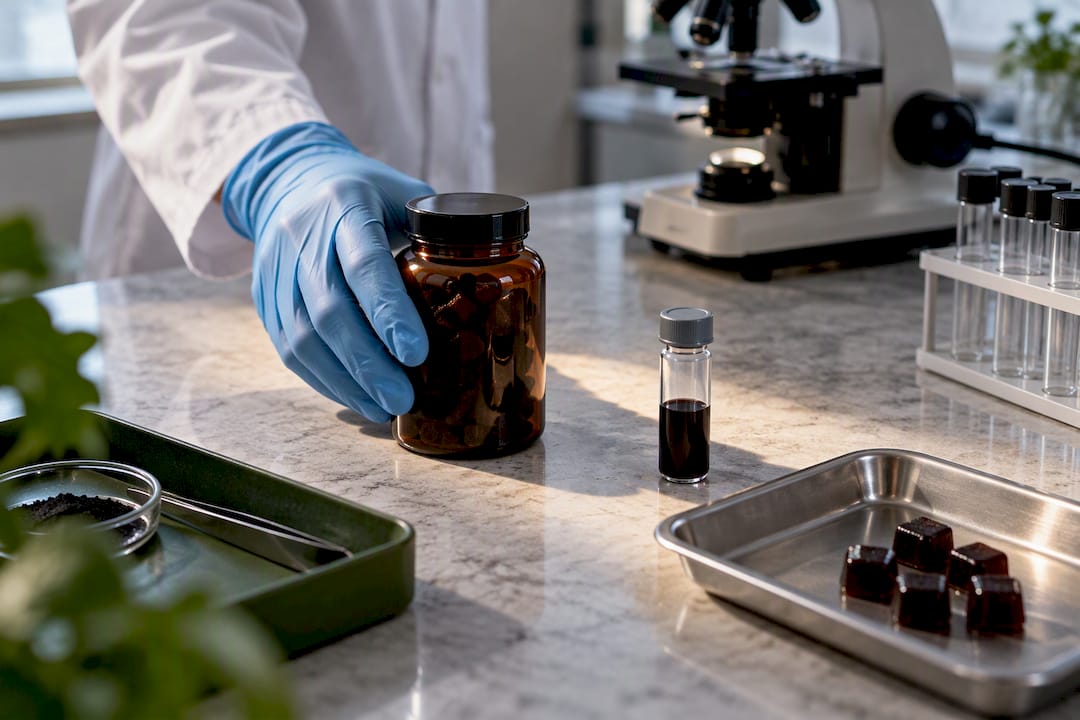
Australia-focused look at shilajit gummies: what human trials actually show, how 500 mg/day dosing compares, and why batch COAs and TGA safety checks matter.