Uncategorized
Shilajit in Pregnancy: Why Doctors Advise Against It and What to Do
Avoid shilajit while pregnant or breastfeeding. No controlled trials, contamination risk, and one case links use to high blood pressure. Inform your…

A trustworthy Shilajit lab report, or Certificate of Analysis, must name an accredited lab, match a lot number to your jar, and list numeric heavy metal results alongside the methods used to get them. Run three checks before you trust any COA: confirm the lab is accredited and reachable, confirm the lot number on the report matches your package, and confirm heavy metals appear as actual numbers with detection limits, not a vague “pass.”
TL;DR:
- A COA must match the lot number on your product and be recent, preferably within the last 12 to 24 months, to ensure relevance to your batch.
- Heavy metal results should be listed with actual numeric values and detection limits, especially for lead, arsenic, cadmium, and mercury, to verify safety against accepted standards.
- Reliable lab accreditation, such as ISO/IEC 17025, and verification of assay methods like ICP-MS or ICP-OES, are essential for trustworthy heavy metal and mineral testing results.
- Fulvic acid percentages require disclosed methods, with chromatography (HPLC or ISO 19822) providing more accurate and comparable measurements than spectrophotometry alone.
- Microbial testing results and moisture content are critical, especially for minimally processed, moist products like Shilajit, to confirm microbial safety and determine concentration reliability.
A Certificate of Analysis is a batch-specific lab assay, commissioned by the brand, that reports what a lab found when it tested one particular lot of product. It is not an independent audit, nor is it a guarantee that every jar on the shelf matches what the paper says. Think of it as a snapshot of one sample, tested once, on one date.
Heavy metals are the one issue that makes or breaks a COA’s usefulness. Shilajit forms in mineral-rich rock over centuries, which means trace metals are a real possibility depending on the source and how the resin was purified. A solid COA shows whether that specific tested batch came in under accepted limits. It does not say anything about the batch you buy six months later.
That is where lot traceability becomes non-negotiable. Reviews of Shilajit’s chemical composition and variability show real differences between harvests, which is exactly why a COA needs a matching lot number to mean anything for the jar in your hand.
Most COAs follow a predictable layout once you know what you’re looking at. Here’s what to check, in the order it usually appears on the page.
Heavy metal results usually appear in parts per million (ppm) or milligrams per kilogram (mg/kg), and the two units are interchangeable for this purpose. What matters is not just the number but where it sits against an accepted limit and how confidently the lab could have detected a problem in the first place.
Reference limits for these four metals commonly draw from United States Pharmacopeia general chapters on elemental impurities, though exact allowable levels can shift depending on jurisdiction and daily dose assumptions. A number that passes under one framework’s assumptions might read differently under another, which is one more reason the method and the limit both need to appear on the page, not just a checkmark.
Industry guidance on Shilajit purity testing methods recommends ICP-MS or ICP-OES for trace metal detection specifically because these techniques can quantify contamination at extremely low concentrations, far below what older colorimetric methods could reliably catch. If a COA doesn’t name one of these methods, ask why.
Pro Tip: Dose matters as much as concentration. A resin with a slightly higher lead reading but a smaller daily serving size can still mean lower cumulative exposure than a “cleaner” product taken in larger amounts. Do the math on your actual serving, not just the raw ppm number.
A fulvic acid percentage on a label means very little without knowing how it was measured. Three methods dominate the space, and they don’t agree with each other.
UV-Vis spectrophotometry is the fastest and cheapest method, but it’s also the least specific. It tends to read broadly across organic acids and can inflate fulvic acid numbers well beyond what a more selective method would show. HPLC (high-performance liquid chromatography) separates and quantifies individual compounds, giving a more defensible number. ISO 19822 is a chromatography-based method built specifically for humic and fulvic substance quantification, and it’s the closest thing this space has to a real standard.
An unusually high fulvic acid claim, north of 50 or 60 percent, deserves a skeptical eye, especially if the COA doesn’t name a method at all. Some brands also blur the line between testing an upstream fulvic acid fraction and testing the actual finished resin you’re buying. Those are two different measurements, and only the finished-product number tells you anything about what’s in your jar.
Shilajit resin is a moist, minimally processed, unpackaged product by nature, which makes microbial testing more relevant than it would be for a dry capsule. A complete COA should include Total Aerobic Microbial Count (TAMC), Total Yeast and Mold Count (TYMC), and confirmation that pathogens like E. coli and Salmonella were not detected.
Moisture content matters too, both for shelf stability and for judging concentration. A resin with unusually high water content can dilute active compounds and create conditions where mold risk climbs.
Verification takes about the same time as reading the report itself. Here’s the sequence worth running every time.
Some warning signs take less than ten seconds to spot once you know to look for them.
Run through this list before you buy, or before you take another dose from a jar you already own.
If two or more of these are missing, ask the seller for the full report before you buy, or walk away.
A responsible vendor treats testing as a per-batch discipline, not a one-time marketing document. The process should run sample from a specific lot to an independent accredited lab, then back to a downloadable COA that’s tied to that exact lot number, available to any shopper before they buy. Shilajit documents its purification and testing process this way, matching each resin batch to its own report rather than reusing one generic document across every sale.
Look for these proof points on any brand’s site, not just Shilajit’s:
That level of disclosure cuts the verification steps above roughly in half, because the brand has already done the matching work for you.
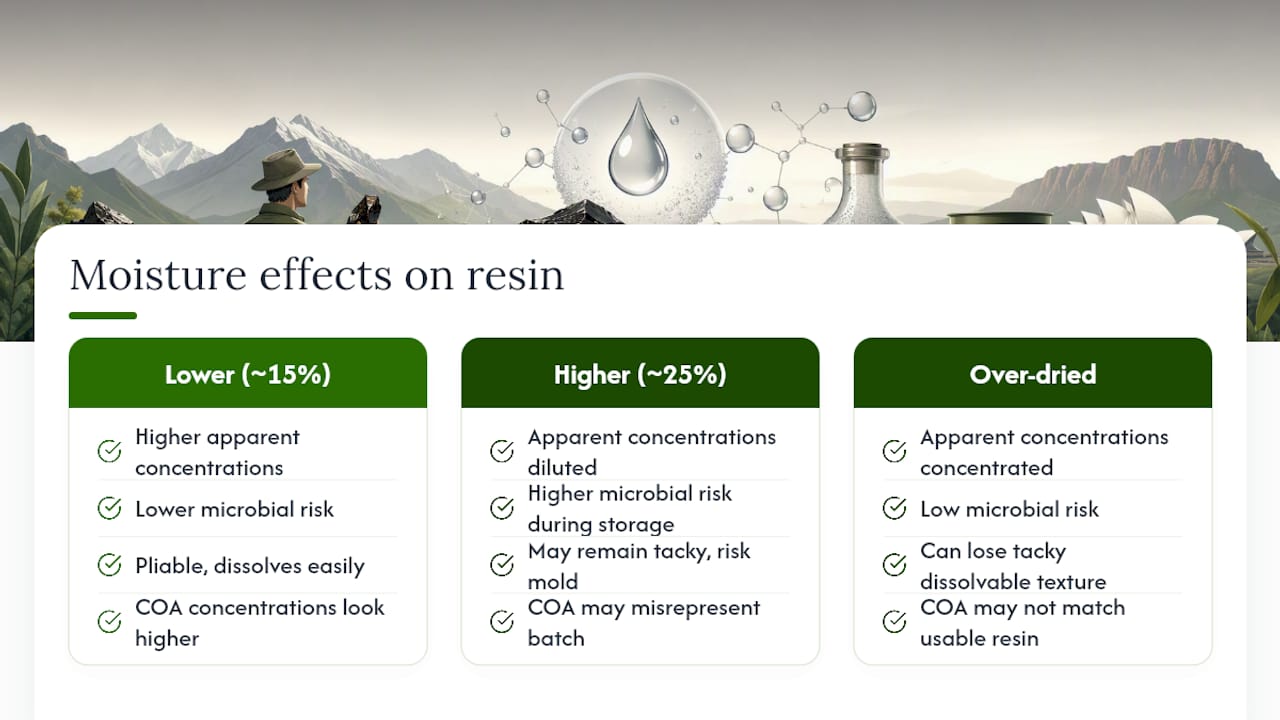
Moisture analysis tells you how much of a Shilajit resin’s weight is actually water rather than mineral and organic material. This matters more than most buyers realize, because every other concentration figure on the COA, including fulvic acid percentage, is calculated against total sample weight. A resin sitting at 15 percent moisture will show different apparent concentrations than the same material at 25 percent moisture, even if the underlying mineral content is identical.
Traditional purification methods aim to reduce moisture to a stable range that resists mold growth while keeping the resin pliable enough to dissolve easily. Resin that’s too wet risks microbial growth during storage and shipping, which is part of why the microbial panel and moisture figure should be read together rather than in isolation. Resin that’s been over-dried can lose some of the tacky, dissolvable texture that traditional Ayurvedic processing is meant to preserve.
If a COA lists a moisture percentage, compare it against the fulvic acid and mineral figures on the same report. A batch with high moisture and a suspiciously high fulvic acid reading might be reporting on a partially dried or non-representative sample rather than the resin you’ll actually receive. Few COAs make this connection explicit, so it’s worth doing the cross-check yourself rather than assuming the lab already accounted for it.
Heavy metals get most of the attention, but a full mineral profile tells you more about whether a resin’s composition matches what’s expected from genuine high-altitude source rock. Silica and alumina (aluminum oxide) commonly show up in mineral analyses of Shilajit because both are naturally present in the sedimentary rock layers where the resin forms.
Neither compound is inherently dangerous at the trace levels typically found in resin, but wildly elevated readings can point to poor filtration during purification or contamination from processing equipment. A COA that includes a broader mineral panel, potassium, calcium, magnesium, iron, alongside the mandatory heavy metals gives you a fuller picture of whether the product’s mineral profile looks like genuine rock exudate or like something diluted or adulterated.
The practical takeaway: don’t dismiss a mineral panel as filler data. If a report lists silica or alumina at levels far outside what comparable resins show, ask the seller what’s driving that number. It could be entirely benign, tied to the specific rock source, or it could indicate a purification step that didn’t fully filter out mineral sediment. Either way, a number with no context is worth a question, not an assumption.
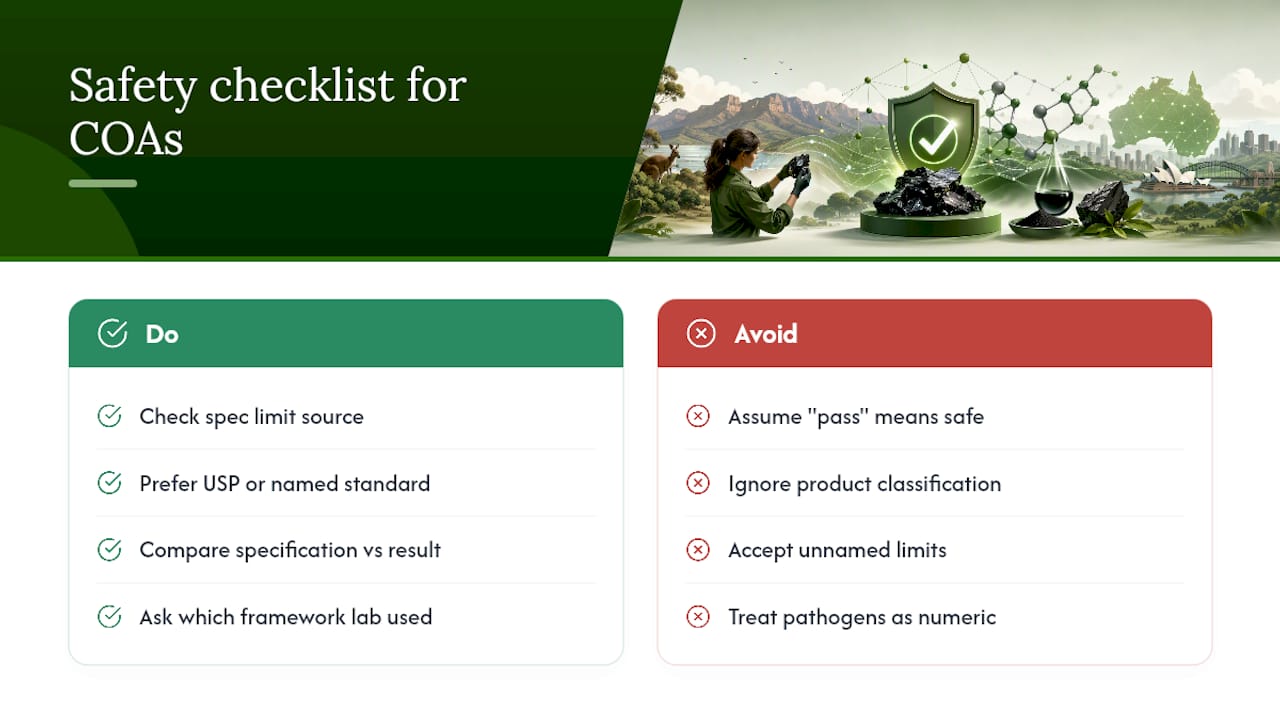
Every contaminant listed on a COA is being measured against some reference point, and knowing where that reference comes from helps you judge whether a “pass” actually means something. For heavy metals, labs commonly reference USP general chapters on elemental impurities, which set allowable daily exposure levels based on route of administration and typical dose.
These thresholds aren’t universal law. Different countries and different labs may apply slightly different allowable limits depending on local regulatory guidance and whether the product is classified as a dietary supplement, a food, or a traditional medicine. That’s part of why the specification limit column on a COA matters just as much as the result column. A batch that “passes” against a lenient limit isn’t automatically passing against a stricter one.
For microbial contaminants, acceptance thresholds for TAMC and TYMC typically follow similar USP-style dietary supplement guidance, with pathogen tests (E. coli, Salmonella) held to a strict absence standard rather than a numeric ceiling. If a COA references a specific standard or chapter number for its limits, that’s a good sign the lab is working from an established framework rather than an arbitrary internal cutoff. If no reference standard is named anywhere on the report, ask the seller which framework the lab used.
Genuine Shilajit resin typically shows a mildly acidic to neutral pH, and a pH reading on a COA can serve as one small authenticity marker alongside the rest of the report. Extreme pH readings in either direction can indicate improper processing, unexpected additives, or a base material that isn’t actually Shilajit resin at all.
pH alone won’t prove authenticity. It’s a supporting data point, not a standalone test, and it works best read alongside the mineral profile and fulvic acid method. A resin with a plausible pH, a full mineral panel, and a named fulvic acid method paints a much more convincing authenticity picture than a resin with any single one of those elements in isolation.
Some sellers also point to solubility in warm water, texture, and smell as informal authenticity checks outside the lab report itself. Those cues are worth combining with a COA, but they’re not a substitute for one. A product that dissolves properly and smells right can still carry a heavy metal problem the smell test will never catch.
Benchmarking one brand’s COA against another only works when you’re comparing the same kind of measurement. Start by lining up the analytical methods first, not the headline numbers. A 45 percent fulvic acid reading from ISO 19822 testing and a 60 percent reading from UV-Vis testing aren’t actually comparable, even though the second number looks more impressive on a label.
Once methods line up, compare specification limits and actual results side by side for each heavy metal, and check whether both reports show LODs low enough to catch trace contamination. A resin reporting “ND” against an LOD of 0.01 ppm has demonstrated more than one reporting “ND” against an LOD of 1 ppm, even though both technically say the same word.
Report freshness belongs in the comparison too. A COA from 18 months ago tells you less than one from three months ago, particularly given the batch-to-batch variability documented across Shilajit harvests. When two products look roughly equal on paper, the one with the more recent test date, the more sensitive detection limits, and the more specific fulvic acid method is the stronger buy, even if its label percentage reads slightly lower.
Fulvic acid gets the marketing spotlight, but it’s one compound among several that define genuine Shilajit resin. Humic acid, a related but distinct class of organic compound, often appears alongside fulvic acid in a fuller composition analysis and contributes to the resin’s overall organic acid profile.
Dibenzo-alpha-pyrones (DBPs) are another marker some labs test for specifically because they’re considered characteristic bioactive compounds in genuine Shilajit, distinct from the humic substance family entirely. Testing for DBPs typically requires HPLC or LC-MS rather than simpler spectrophotometric methods, which is part of why their presence on a COA is a reasonably good sign the brand invested in thorough, chromatography-based analysis rather than a quick colorimetric check.
Peer-reviewed research on Shilajit’s pharmacological constituents treats fulvic acid, humic acid, and DBPs as a related but chemically distinct set of markers, all relevant to understanding what makes a sample authentic. A COA that only tests fulvic acid, and skips humic acid or DBPs entirely, isn’t necessarily reporting on a fake product. It’s simply a narrower test. Brands that go further and test for the fuller compound profile are giving you more to verify against, which is generally worth favoring when two products are otherwise comparable.
The biggest mistake shoppers make with Shilajit COAs is scanning straight for the fulvic acid percentage and stopping there. That number is close to meaningless without knowing the method behind it, and the gap between what UV-Vis and ISO 19822 report on the same sample can be large enough to make an average resin look exceptional on paper.
Conventional buying advice tends to treat a high fulvic acid claim as the mark of a premium product. It should be treated as a question, not an answer, until the method column backs it up. The same goes for a heavy metals section that reads “pass.” A pass with no numbers is a brand asking you to trust it rather than proving it.
What actually protects a buyer is the boring stuff: an accredited lab you can look up, a lot number that matches your jar, and detection limits low enough to mean something. Vendors that publish full, lot-matched, method-labeled reports are doing the harder, less flattering work of transparency. That kind of documentation, matching a batch to its own accredited lab report rather than a recycled marketing PDF, is what separates a COA worth trusting from one that’s just there to look official.
Some vendors publish lot-specific lab reports for their resin, naming the accredited labs behind each result rather than asking you to take a percentage on faith. Every batch may be matched to its own testing documentation, covering heavy metals, fulvic acid method, and microbial results, to help ensure reports on a website match the jar received.
If you want to see what that looks like in practice, the pure Shilajit resin product page links to the current batch’s documentation, and support can walk you through verifying the lab and lot match if you have questions before you order. For a deeper look at how purity and potency testing shapes what ends up in the jar, the guide to Himalayan Shilajit purity covers the sourcing side in more detail. Check the current batch’s COA before you order, and you’ll know exactly what you’re taking before it arrives. Connect with us on Facebook for product updates, educational content and information about our quality testing process.
Peer-reviewed research documents Shilajit’s fulvic acid and mineral composition, though most clinical studies rely on purified, standardized material rather than raw, untested resin, which is exactly why COA documentation matters for connecting a product to that evidence.
Shilajit is not an approved treatment for erectile dysfunction, and no COA can verify a health claim like that since a lab report only tests purity and composition, not clinical effect. Any potential support for sexual vitality relates to its broader mineral and energy profile, not a drug-like mechanism.
There’s no COA field or lab test that speaks to ADHD, and no established clinical evidence supports Shilajit as an ADHD treatment. A lab report can only confirm what’s in the product, not what it treats.
A COA won’t answer that question since it measures composition, not personal response. What it can confirm is that you’re taking a genuine, contaminant-tested resin, so any changes you notice in energy or focus are coming from an actual verified product rather than an unknown substance.
The lot number is what ties a lab report to your specific jar rather than a different batch entirely, since Shilajit composition varies between harvests. A COA with no matching lot number tells you nothing about the product you actually own.
Avoid shilajit while pregnant or breastfeeding. No controlled trials, contamination risk, and one case links use to high blood pressure. Inform your…
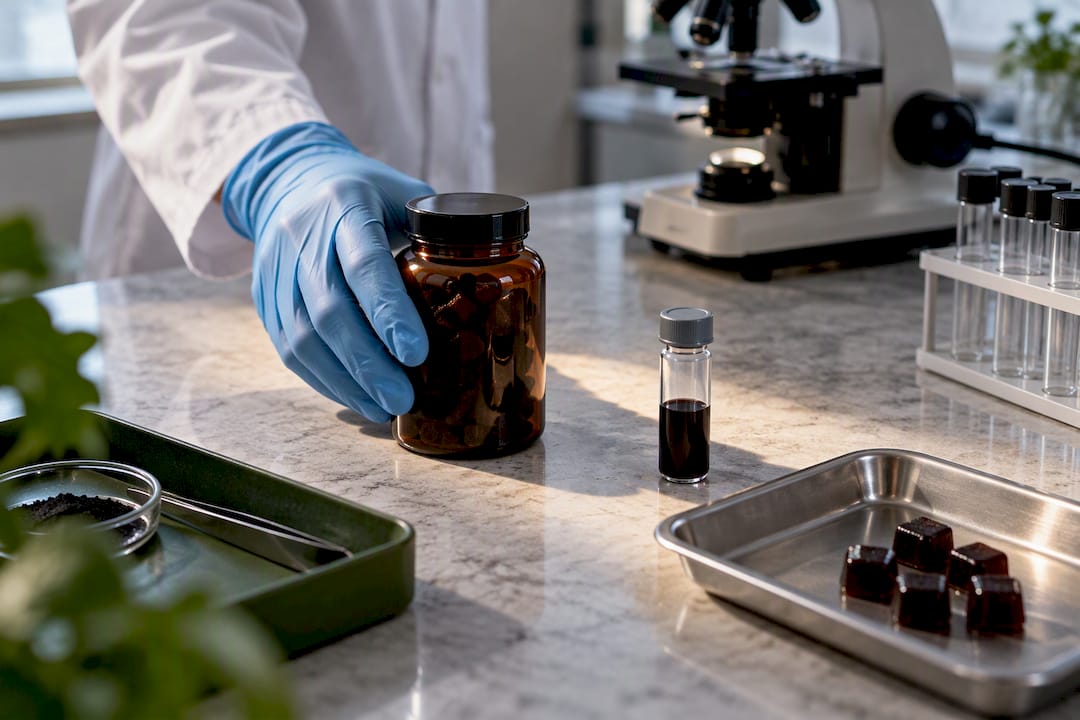
Australia-focused look at shilajit gummies: what human trials actually show, how 500 mg/day dosing compares, and why batch COAs and TGA safety checks matter.