
Uncategorized
Shilajit in Pregnancy: Why Doctors Advise Against It and What to Do
Avoid shilajit while pregnant or breastfeeding. No controlled trials, contamination risk, and one case links use to high blood pressure. Inform your…


Your body is not a fixed structure. It is a continuous rebuilding project, and how well that project runs determines your energy, recovery speed, cognitive sharpness, and how you age. Cellular regeneration, the biological process of replacing and restoring damaged or missing cells and tissues, sits at the root of all of it. As summarized in Nature (2023), aging is not a one-way street; modern regenerative strategies prove that cellular function can be improved and youthful characteristics restored, reframing aging from passive decline to something you can actively influence.
Three facts worth holding onto:
Regeneration is the process of replacing or restoring damaged or missing cells, tissues, organs, and even entire body parts to full function, according to the National Institute of General Medical Sciences. That definition covers a wide range of biological events, from a skin cell replaced after a sunburn to a liver partially regrowing after surgical removal.
The key distinction is between repair and regeneration. Repair patches damage, often with scar tissue that restores structure but not full function. Regeneration restores the original cell type and functional capacity. Scar tissue in the heart after a heart attack is repair. A salamander regrowing a limb is regeneration. Humans sit somewhere in between, with strong regenerative capacity in some tissues and almost none in others.
High-turnover tissues, skin, gut epithelium, and blood cells, replace themselves constantly. Low-turnover tissues, the heart muscle and most neurons, have minimal replacement capacity. Animal models like planarians, zebrafish, and salamanders reveal mechanisms such as blastema formation and dedifferentiation that humans largely lack. This is why translating animal regeneration research into human therapies is harder than headlines suggest.
Stem cells and their surrounding niches are central to the picture. So is compensatory hypertrophy, where remaining cells grow larger to compensate when neighbors are lost, a common response in the kidney and heart.
Five mechanisms determine how well your cells regenerate:
Stem cells and niches. Every regenerative tissue has a stem cell population housed in a protective niche. Aging changes niche function, stem cell quiescence, and differentiation bias, meaning older stem cells are less responsive and more likely to produce the wrong cell types.
Cellular senescence and SASP. Senescent cells have stopped dividing but refuse to die. They secrete a cocktail of inflammatory signals called the senescence-associated secretory phenotype (SASP), which damages neighboring healthy cells and degrades tissue function over time.
Autophagy and mitophagy. These are the cell’s internal cleanup systems, breaking down damaged proteins and dysfunctional mitochondria. True cellular health depends as much on clearance through autophagy and mitophagy as on new cell production. Skip the cleanup, and dysfunctional components accumulate even when new cells are being made.
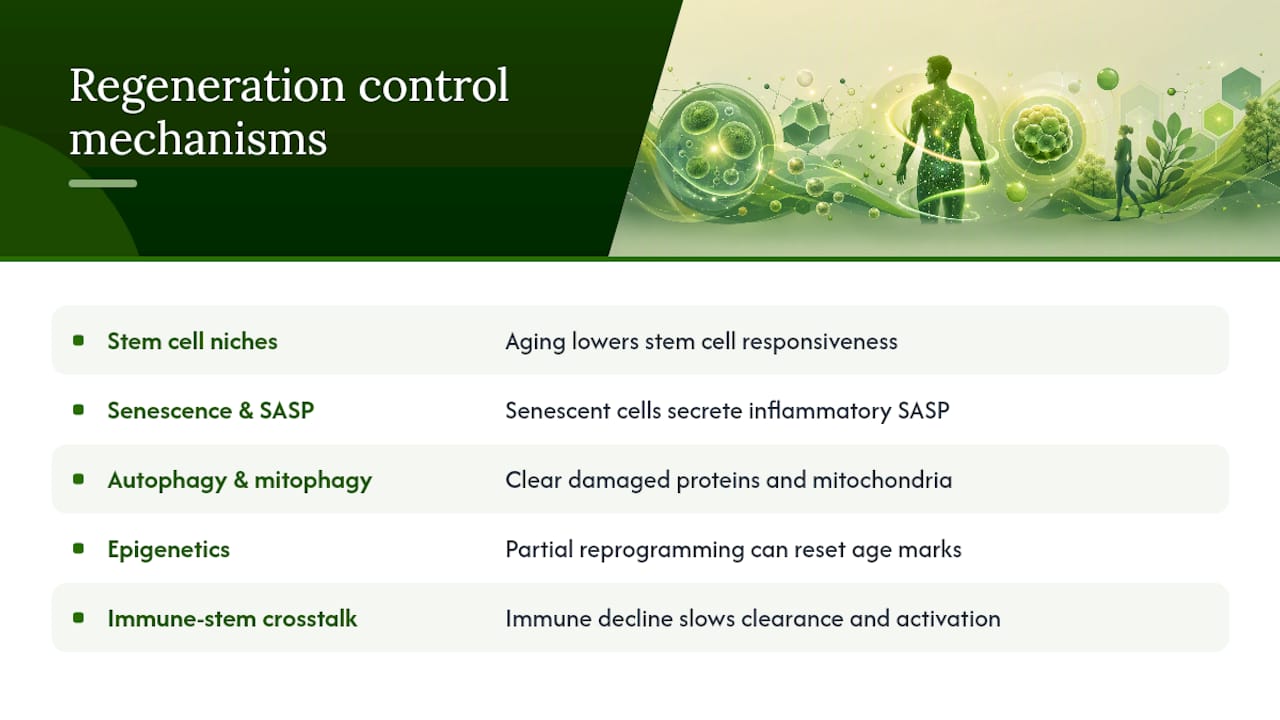
Epigenetics and partial reprogramming. Gene expression patterns shift with age in ways that suppress regenerative programs. Partial reprogramming, resetting some of those epigenetic marks without full dedifferentiation, is one of the most exciting experimental directions in regenerative science.
Immune-stem cell crosstalk. The immune system clears senescent cells and signals stem cells to activate. When immune function declines, both clearance and regeneration slow.
“Various rejuvenation methods include cellular reprogramming, removal of senescent cells and suppression of SASP, metabolic manipulation, stem-cell-associated therapy, dietary restriction, immune rejuvenation, and heterochronic transplantation.” PMC comprehensive review
The cancer trade-off is real. Mechanisms that drive regeneration, particularly those that push cells to proliferate, also raise cancer risk if not tightly regulated. This is why experimental therapies require careful safety monitoring.
| Tier | Examples | Evidence Status | Safety Note |
|---|---|---|---|
| Established | Adequate sleep duration per night, resistance training, protein timing, caloric restriction patterns | Strong human evidence | Low risk; consult a physician for specific conditions |
| Emerging | Senolytics (quercetin, dasatinib), NAD+ precursors, time-restricted eating | Early human trials; animal data strong | Variable safety profiles; some require clinical supervision |
| Experimental | Partial reprogramming, CAR-T adaptations, allogeneic stem cell infusions | Preclinical or Phase I/II trials | Significant unknowns; only in approved trial settings |
Lifestyle basics remain the most evidence-backed tier. Resistance training stimulates satellite cell activation. Sleep is when growth hormone peaks and cellular repair accelerates. Protein distributed across meals, rather than loaded at one sitting, supports muscle protein synthesis more effectively.
Senolytics, compounds that selectively clear senescent cells, show early promise. Dasatinib combined with quercetin has been tested in small human trials with functional improvements in frailty markers, though effect sizes and durability remain uncertain. NAD+ precursors like nicotinamide riboside support mitochondrial function in animal models, with mixed but cautiously positive early human data.
Experimental cell therapies and partial reprogramming are not consumer options today. They belong in clinical trial settings with full safety monitoring.
Sleep is the most underused regenerative tool most people have. Adequate sleep allows growth hormone secretion, glymphatic clearance in the brain, and tissue repair cycles to complete. Cutting it short consistently is one of the fastest ways to accelerate cellular aging.

Regular resistance training activates muscle satellite cells and signals the body to maintain lean tissue. Combine that with distributing a moderate amount of protein per meal across the day rather than concentrating it at dinner.
Time-restricted eating, compressing meals into an 8–10 hour window, supports autophagy by extending the overnight fasting period. You do not need extreme caloric restriction to get meaningful benefit.
For supplements, prioritize third-party tested products with published lab reports showing purity, active compound content, and absence of heavy metals. Fulvic acid, found in high-quality mineral resins, supports nutrient transport at the cellular level and is worth evaluating as an adjunct to lifestyle measures.
Pro Tip: Before adding any supplement targeting cellular health, get a baseline panel including fasting glucose, CRP (C-reactive protein), and a complete metabolic panel. These give you a functional starting point to measure against.
The cancer-regeneration trade-off deserves plain language. Signals that tell stem cells to proliferate are the same signals that, when dysregulated, drive tumor growth. This is not a reason to avoid all regenerative strategies, but it is a reason to be skeptical of anything that claims to “maximize” stem cell activity without safety data.
“Preclinical rejuvenation approaches, including partial reprogramming and senotherapy, can restore youthful traits in animal models, but translation to safe, durable human therapies requires substantially more trial data and long-term safety evidence.” PMC review
Current research gaps include: standardized biomarkers for measuring “rejuvenation” in humans, long-term outcome data for most senolytic protocols, and reliable delivery and engraftment strategies for cell therapies. Organ-specific challenges in regenerative cell therapy, including delivery, engraftment, and anatomy, mean some organ therapies remain far from routine clinical use.
For any invasive or experimental intervention, consultation with a board-certified physician is not optional. This article is general health information, not medical advice.
Lifestyle changes produce measurable cellular signals, improved mitochondrial markers, reduced inflammatory cytokines, within weeks to a few months of consistent practice. Subjective improvements in energy and recovery often appear within four to eight weeks.
Supplement effects, where they exist, typically require two to three months of consistent use before meaningful assessment is possible.
Clinical cell therapies and trial-based interventions operate on timelines of months to years, with costs that can run from several thousand dollars for early-access programs to tens of thousands for investigational therapies. Most are not covered by insurance outside of approved clinical trial participation.
Enrolling in a clinical trial at ClinicalTrials.gov is a legitimate lower-cost route to accessing experimental regenerative therapies, though inclusion criteria are strict and participation involves real time commitments and monitoring requirements.
Cellular regeneration is the root-level biological process that determines tissue function, recovery speed, and how well you age, and lifestyle choices remain the most evidence-backed way to support it.
| Point | Details |
|---|---|
| Regeneration vs. repair | Regeneration restores original cell types and function; repair often leaves scar tissue that lacks full capacity. |
| Lifestyle is tier one | Sleep, resistance training, protein timing, and time-restricted eating have the strongest human evidence for supporting cellular renewal. |
| Evidence tiers matter | Senolytics and NAD+ precursors are emerging; partial reprogramming and cell therapies are experimental and belong in clinical trial settings only. |
| Safety trade-offs are real | Signals that drive cell proliferation also carry cancer risk; any experimental intervention requires clinical supervision and safety monitoring. |
| Shilajit as an adjunct | Shilajit’s lab-tested, fulvic-acid-rich resin supports cellular nutrient delivery as a complement to lifestyle-first regenerative strategies. |
The regenerative medicine field is producing genuinely exciting results. Senolytics clearing aged cells, partial reprogramming resetting epigenetic clocks in mice, stem cell niches being coaxed back toward youthful behavior. These are not science fiction.
What concerns me is how quickly that science gets translated into consumer marketing claims that skip the “early trials, uncertain durability, significant unknowns” part. The gap between a promising mouse study and a safe, effective human therapy is wide, and that gap has cost people money and occasionally health when they assumed otherwise.
The most defensible position for anyone serious about cellular health is to build the lifestyle foundation first, because that foundation has the strongest human evidence and the lowest risk. Then evaluate adjunct options, supplements included, with the same skepticism you’d apply to any health claim: ask for the evidence tier, the safety data, and the third-party verification. Optimism about regenerative science is warranted. Uncritical acceptance of every product that borrows its language is not.
If you’ve built the lifestyle foundation and want a well-sourced adjunct, Shilajit’s pure Himalayan Shilajit resin is worth considering. Shilajit resin is naturally rich in fulvic acid, a compound that supports mineral transport across cell membranes and mitochondrial energy production, two processes directly relevant to cellular maintenance. Every batch is third-party tested with published lab reports covering fulvic acid content, heavy metal screening, and microbial safety.
For readers who want to understand the active compound in detail, Shilajit’s guide on fulvic acid benefits and dosing covers the evidence, safety considerations, and realistic expectations clearly. Quality checklist before buying any resin: confirm the certificate of analysis is from an independent lab, check that fulvic acid percentage is stated (not just implied), verify ash content and heavy metal limits, and confirm the sourcing region. Shilajit publishes all of this. Start with a small daily amount, assess over 60–90 days, and pair it with the sleep, movement, and nutrition practices that do the heavy lifting.
To search for active regenerative medicine trials, visit ClinicalTrials.gov and search “regenerative medicine,” “senolytics,” or “stem cell therapy” filtered by your condition and location. Review inclusion criteria carefully before contacting a trial site.
Avoid shilajit while pregnant or breastfeeding. No controlled trials, contamination risk, and one case links use to high blood pressure. Inform your…
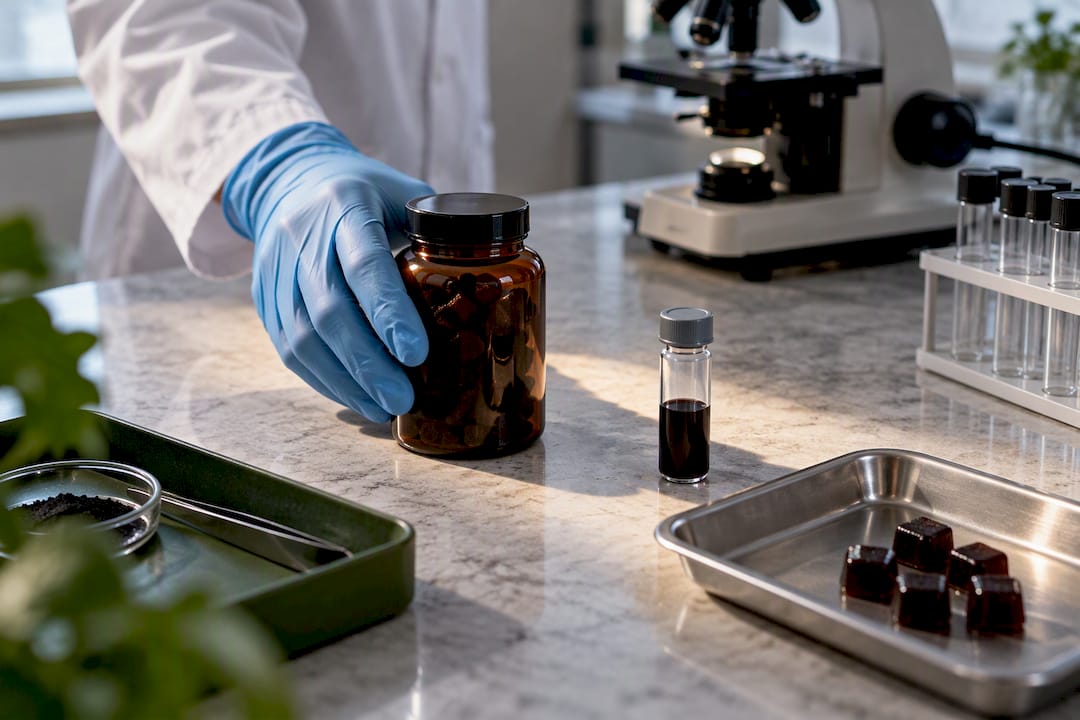
Australia-focused look at shilajit gummies: what human trials actually show, how 500 mg/day dosing compares, and why batch COAs and TGA safety checks matter.