Uncategorized
Shilajit in Pregnancy: Why Doctors Advise Against It and What to Do
Avoid shilajit while pregnant or breastfeeding. No controlled trials, contamination risk, and one case links use to high blood pressure. Inform your…

Short answer: no, you should not take shilajit while breastfeeding unless a qualified clinician has reviewed your specific situation and cleared it. Two things drive that recommendation: nobody has studied whether shilajit’s compounds pass into breast milk, and independent lab testing has found some shilajit products contaminated with heavy metals above safe limits. The sections below walk through the evidence gap, the contamination data, safer options for common postpartum complaints, and what to do if you’ve already taken a dose.
TL;DR:
- There are no human studies confirming whether shilajit passes into breast milk or affects nursing infants, leading health authorities to advise against use during breastfeeding.
- Independent lab tests have documented heavy-metal contamination in some shilajit products, with levels exceeding safety limits, especially for mothers worried about infant exposure.
- A trustworthy COA should specify tested elements, laboratory details, batch number, and testing date; however, passing contamination tests does not prove safety for breastfeeding.
- Safer postpartum options include iron testing, thyroid screening, improving sleep, addressing mental health, and consulting a lactation specialist for milk supply issues.
- Mothers who have taken shilajit while breastfeeding should stop immediately, monitor their baby for adverse signs, and seek urgent medical advice if concerning symptoms occur.
There is no human lactation research on shilajit. Not a small study, not a case report, nothing that measures whether its compounds show up in breast milk or affect a nursing infant. That absence of data is the entire problem, and it’s why the guidance from major health resources is uniformly cautious rather than reassuring.
WebMD’s entry on shilajit states plainly that it’s not known whether shilajit passes into breast milk, and advises telling your healthcare provider if you’re breastfeeding before using it. Healthdirect, Australia’s government-backed health information service, takes the same position on complementary medicines generally: many lack any breastfeeding safety data at all, and the standard advice is to check with a doctor or pharmacist before starting something new while nursing. That’s not boilerplate caution. It reflects a genuine information vacuum.
Healthdirect also makes a point worth sitting with: complementary medicines can have real pharmacological effects, can interact with other medicines you’re taking, and can potentially affect your baby or your milk supply. “Natural” is a marketing word, not a safety classification. Shilajit is a mineral-rich substance exuded from rock at high altitude, and it contains genuinely active compounds like fulvic acid alongside dozens of trace minerals. Active compounds are exactly the kind of thing you want studied before introducing them into a nursing relationship, not assumed safe by default.
Banner Health’s clinical guidance on shilajit goes further, listing pregnant and breastfeeding people alongside children as groups who should not use the supplement at all, citing both the missing safety data and contamination concerns.
Here’s the pattern across every credible source we reviewed:
The evidence gap in one line: zero lactation studies plus multiple independent health authorities advising against use is about as clear a “wait” signal as you’ll find in supplement safety.
Even setting aside the lactation question, shilajit carries a documented contamination problem that predates any breastfeeding discussion. A 2021 peer-reviewed elemental analysis published and indexed on PubMed tested shilajit samples from India and Pakistan using three separate analytical methods, including ICP-MS and EDX. The researchers found toxic elements, including lead, arsenic, and mercury, in some samples, with certain measured concentrations exceeding permissible safety limits.
That matters for breastfeeding mothers specifically because heavy metals are exactly the category of contaminant most likely to cross into breast milk and accumulate in an infant’s developing system. Lead and mercury don’t need a mechanism of “shilajit’s active compounds” to be dangerous. They’re dangerous on their own, regardless of what plant or mineral source they arrived in.
The deeper issue is that shilajit isn’t one standardized product. It’s a raw exudate harvested from rock crevices across different regions of the Himalayas, the Altai Mountains, and other high-altitude ranges, then processed with wildly varying degrees of purification. Two jars labeled “pure shilajit resin” can come from different mountains, different soil chemistry, and different filtration processes, and land at completely different contamination profiles. A single manufacturer’s purity claim tells you nothing about a different manufacturer’s product, and it doesn’t even guarantee consistency batch to batch from the same source.
This is where a Certificate of Analysis, or COA, becomes the only real check you have. A COA worth trusting should show:
A label that just says “heavy-metal tested” with no numbers attached tells you almost nothing. Ask for the actual report.
Pro Tip: When you request a COA from any seller, check that the batch number on the document matches the batch number on your product packaging. Sellers sometimes provide a COA from a different production run than the one you’re actually holding, and the numbers won’t mean anything if they don’t match. You can see what a genuine batch report looks like on Shilajit’s own purity testing breakdown and its COA checklist.
One caveat that matters more than any of the above: even a spotless COA showing zero heavy metals does not answer the breastfeeding question. Contamination testing tells you a product is clean. It says nothing about whether shilajit’s own compounds, cleanly sourced or not, are safe for a nursing infant. Those are two separate questions, and passing one doesn’t resolve the other.
Most mothers who go looking for shilajit while breastfeeding aren’t chasing a trend. They’re exhausted, recovering from birth, worried their energy hasn’t come back, or anxious about whether they’re making enough milk. Those are real problems. Shilajit just isn’t the evidence-backed way to solve them right now.
Postpartum fatigue has several distinct causes, and each one has a specific, testable fix that doesn’t carry an unknown risk profile:
On that last point, resist the pull toward using shilajit as a galactagogue. Healthdirect is direct about this: herbal remedies marketed to increase milk supply generally lack sufficient evidence to be recommended, and there is no clinical trial data showing shilajit does anything for milk production. If supply is genuinely low, a lactation consultant can assess latch, feeding frequency, and other mechanical factors that actually move the needle, something no herbal supplement has been shown to do.
Stop taking further doses right away. That’s the first and most important step, and it costs nothing to do immediately while you sort out the rest.
Keep the product packaging, note the batch number, and pull up any COA the seller provided. If you need to describe exactly what you took to a healthcare provider, having the label and batch details in hand makes that conversation faster and more useful.
Watch your baby closely over the following hours and days for anything out of the ordinary:
If you notice any of these, don’t wait for a routine appointment. Contact your local Poison Information service, your baby’s pediatrician, or go to an emergency department right away. In Australia, the Poisons Information Centre is reachable on 13 11 26, anywhere in the country, 24 hours a day.
One more thing worth saying clearly: don’t rely on “pump and dump” as a fix. Timing strategies work for substances where researchers actually know how long a compound stays in breast milk. Nobody has that data for shilajit, so there’s no scientifically grounded window to wait out. If you’re worried, the right move is calling a health professional, not guessing at a timeline.
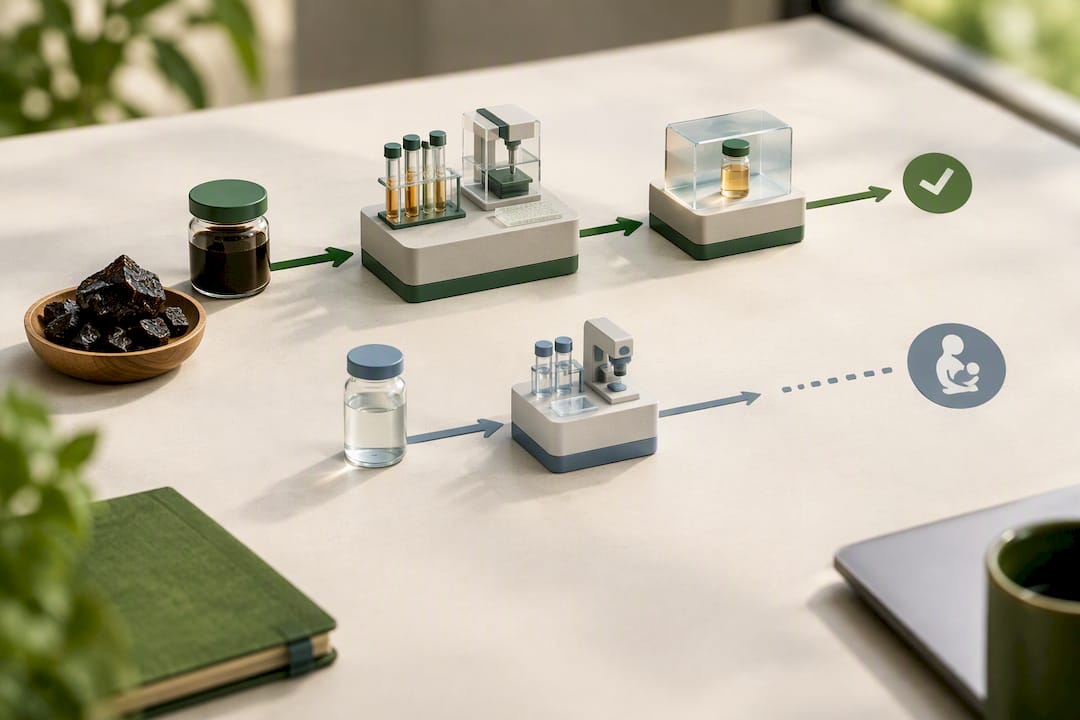
Some sellers test batches for heavy metals and may publish the methodology behind that testing, because a purity claim without a lab report attached isn’t worth much to anyone. That transparency exists to answer one specific question: is this batch free of dangerous contamination. You can see how that process works on a purification and lab testing page.
Here’s the distinction we want to be completely honest about. A clean COA tells you a batch passed contamination screening. It does not, and cannot, tell you shilajit itself is safe during breastfeeding, because that clinical question has never been studied in nursing mothers or their infants. Those are different questions, and no amount of lab rigor on our end changes the fact that lactation research on shilajit simply doesn’t exist yet.
If you’re a healthcare provider or lactation consultant evaluating a patient’s situation, you may request batch-specific COAs from some sellers. Contact customer service with the batch number to obtain documentation for clinical evaluation.
The conventional wisdom around herbal supplements and breastfeeding tends to split into two unhelpful camps: blanket reassurance that “natural” means safe, or blanket fear that treats every supplement as equally dangerous. Neither serves a tired new mother trying to make a reasonable decision at 2 a.m.
The more useful frame is this: absence of evidence is not evidence of safety, especially for a substance with documented contamination problems in some products on the market. That’s not fearmongering, it’s just an honest read of what the research does and doesn’t show. Where we think the standard advice falls short is in stopping at “ask your doctor” without giving mothers the specific, testable alternatives for the actual problem driving them toward shilajit in the first place, whether that’s fatigue, low iron, or supply anxiety. Get those questions answered directly instead of reaching for a supplement with an unknown safety profile as a workaround.
Prioritize the blood test over the supplement. It’s cheaper, faster, and it might solve the actual problem.
— Shilajit
If you’re not currently breastfeeding, or your clinician has specifically reviewed and cleared shilajit for your situation, Some sellers offer batch-tested Himalayan resin with lab reports available, providing documentation of the product’s purity. That’s the practical advantage over buying an unverified product online: you get a documented purity profile instead of a marketing claim.
Browse the current shilajit resin range to see formats and batch information, or check the dosage guide if you’re planning ahead for when breastfeeding ends. To be clear again: none of this is a recommendation to use shilajit while nursing without medical clearance. If you want a batch-specific COA before making any decision, our team can send it. Just reach out with the product batch number and we’ll have it to you directly.
This article is general information, not a substitute for advice from a qualified doctor. Consult a qualified healthcare professional about your own circumstances before acting on anything here.
Health authorities recommend against it unless a doctor or pharmacist has specifically reviewed your case. Neither WebMD nor healthdirect has any data confirming it’s safe, and that unknown status is treated as a reason for caution, not reassurance.
Any supplement without documented breastfeeding safety data deserves a conversation with your doctor or pharmacist first, since complementary medicines can affect a baby or your milk supply even when they’re marketed as natural. Shilajit falls into this category due to its unstudied lactation profile and known contamination risks in some products.
Shilajit is generally marketed for energy, mineral support, and vitality in adults, but its effects haven’t been studied in pregnant or breastfeeding populations. Banner Health specifically advises against use during pregnancy and breastfeeding due to insufficient safety evidence and possible heavy-metal contamination.
There’s no strong evidence that shilajit decreases milk supply, but there’s also no evidence it helps. Herbal remedies claiming to increase or protect supply are generally under-researched, and healthdirect advises against relying on them in place of a lactation consultant’s assessment.
Once you’re no longer nursing, the specific lactation caution no longer applies, though contamination risk from unverified products still does. Choose a product with a batch-specific COA showing tested heavy-metal levels, like the ones available on Shilajit’s product pages, and talk to your doctor if you have any underlying health conditions.
Avoid shilajit while pregnant or breastfeeding. No controlled trials, contamination risk, and one case links use to high blood pressure. Inform your…
Australia-focused look at shilajit gummies: what human trials actually show, how 500 mg/day dosing compares, and why batch COAs and TGA safety checks matter.